
How Lease Extensions and Renewals Work (And Which One Saves You Money)
Whether you’re a landlord managing multiple properties or a tenant who loves your current rental, understanding the difference between lease extension and lease renewal is critical. While both aim to continue a rental arrangement beyond its original end date, they come with different legal implications, contractual terms, and practical outcomes.
In this guide, we’ll explore what each term means, how they affect both parties, and how to decide which option best suits your situation.
Quick Summary: Lease Extension vs. Lease Renewal
| Aspect | Lease Extension | Lease Renewal |
|---|---|---|
| Definition | Continues the original lease with adjusted end date | Creates a brand-new lease agreement |
| Contract | Keeps original lease terms in place | May include new terms, rent changes, or updated clauses |
| Legal Treatment | Considered a continuation of the old lease | Treated as a new, standalone lease |
| Best For | Short-term continuation without renegotiation | Long-term continuation with updated conditions |
| Flexibility | Less flexibility in changing terms | More flexibility to rewrite lease terms |
What Is a Lease Extension?
A lease extension means the original lease agreement stays in place, but the expiration date is pushed forward. All other terms—such as rent, rules, security deposit, and maintenance obligations—remain unchanged unless specifically modified in writing.
Example:
Let’s say your lease ends on August 31, 2025, and both parties agree to extend it until December 31, 2025. The original lease terms continue to apply, just with a new end date.
When to Use a Lease Extension:
- You want a short-term arrangement (1–6 months).
- Both parties are happy with the current lease terms.
- The tenant plans to move soon but needs a little more time.
- The landlord is planning to sell or renovate the unit after the extension.
Pros of Lease Extension:
- Simple and quick to execute.
- Retains legal consistency with the original lease.
- No need to renegotiate all terms.
Cons:
- No opportunity to change outdated clauses.
- May restrict rent adjustments unless specified.
What Is a Lease Renewal?
A lease renewal involves the creation of a new lease agreement, often with new terms, dates, and rental rates. Even if it’s with the same tenant and for the same property, a renewed lease is legally viewed as a new contract.
Example:
Your original lease ends on August 31, 2025, and you sign a new 12-month lease starting September 1, 2025, with a rent increase or modified rules.
When to Use a Lease Renewal:
- You want to update lease terms (e.g., rent increase, pet policy, maintenance clauses).
- You’re committing to a longer-term agreement.
- Local rental laws require a formal renewal process.
- You’re switching to a month-to-month lease after a fixed-term lease ends.
Pros of Lease Renewal:
- Opportunity to adjust rent and update terms.
- Provides fresh documentation for legal and record-keeping purposes.
- Helps clarify rights and responsibilities under new circumstances.
Cons:
- Requires more paperwork and negotiation.
- Tenant may decide not to renew.
Legal Differences Between Extension and Renewal
From a legal standpoint, the key difference lies in how the agreements are interpreted in court.
- Extension: Treated as a continuation of the same contract. In case of a dispute, the original lease remains the basis for interpretation.
- Renewal: Treated as a new agreement, meaning any clauses or legal terms reset with the new start date.
Common Mistakes to Avoid
Mistake #1: Assuming They’re the Same Thing
Many landlords and tenants mistakenly believe “extension” and “renewal” are interchangeable. This confusion can lead to invalid agreements or unintended lease terms.
Mistake #2: Failing to Put It in Writing
Verbal agreements on extensions or renewals rarely hold up in court. Always sign a written agreement—even if you’re only extending the lease for a month or two.
Mistake #3: Overlooking Local Laws
Some states and cities have specific regulations about lease renewals and terminations. For example, rent control laws may restrict rent increases during renewal but not during extensions.
Lease Extension Sample Clause
“This lease is extended for an additional period of 3 months, commencing September 1, 2025, and ending November 30, 2025, under the same terms and conditions as stated in the original lease dated September 1, 2024.”
Lease Renewal Sample Clause
“The parties hereby agree to enter a new lease agreement commencing September 1, 2025, for a period of 12 months, with rent set at $1,350/month. All terms of the previous lease are void unless expressly included in the new agreement.”
Which One Should You Choose?
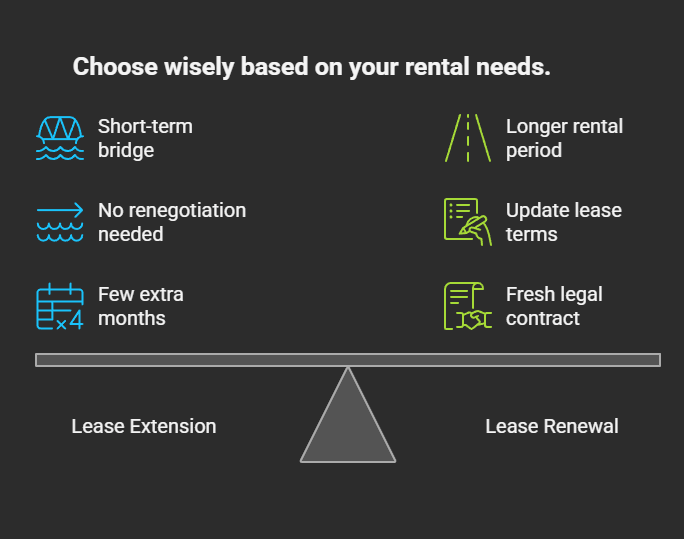
Choose Lease Extension if:
- You want a short-term bridge to buy time.
- The tenant needs a few extra months.
- You don’t want to deal with renegotiation.
Choose Lease Renewal if:
- You’re committing to a longer rental period.
- You want to update lease terms or increase rent.
- You need a fresh legal contract for documentation or compliance.
Pro Tip for Landlords:
If you plan to increase rent, change utility responsibilities, or adjust property rules, go with a lease renewal, not an extension. This gives you a chance to revisit and reinforce all terms of the agreement.
Final Thoughts
Understanding the distinction between a lease extension and a lease renewal isn’t just a matter of terminology—it’s a matter of legal clarity, financial strategy, and long-term protection for both landlords and tenants. Misunderstanding or misapplying these terms can lead to disputes, voided agreements, unintended liabilities, and even legal action.
For landlords, knowing which option to choose—extension or renewal—can help maintain cash flow stability, avoid tenant turnover, and ensure that your rental operations remain legally compliant and efficient. A renewal might be your chance to update outdated clauses, increase rent fairly, or shift maintenance responsibilities. On the other hand, a lease extension could be the perfect short-term bridge as you prepare for property renovations or decide whether to sell.
For tenants, choosing the right path can mean the difference between staying in your home with peace of mind or facing unexpected changes in rent, terms, or tenancy status. A lease renewal offers a fresh start and longer-term housing security, while an extension might buy you time while you search for your next move or finalize relocation plans.
In either case, communication is key. Both parties should openly discuss their expectations and goals for the continued tenancy. Don’t rely on assumptions or verbal agreements—everything should be documented and signed. If there are any uncertainties about the language, structure, or implications of your lease documentation, it’s wise to consult a real estate attorney or lease expert familiar with your local landlord-tenant laws.
Ultimately, whether you’re looking to extend the lease for convenience or renew it for long-term security, having a clear understanding of these legal tools empowers you to make informed, confident decisions. The right approach ensures not only the protection of your property or home—but also a stronger, more professional landlord-tenant relationship going forward.
FAQs:
1. Do lease extensions require a new signature?
Yes. Both parties must sign an addendum or extension agreement.
2. Can I increase rent during a lease extension?
Only if it’s clearly written into the extension terms. Otherwise, the original rent stays the same.
3. What if the tenant refuses to sign a renewal?
Then the lease expires as planned. You can either move forward with a month-to-month tenancy (if allowed) or begin the process of finding a new tenant.
4. Can lease renewals be automatic?
Yes, some leases have automatic renewal clauses unless notice is given. Always read the fine print.
5. What’s better for tenants—renewal or extension?
Extensions offer flexibility, while renewals provide longer-term security. The right option depends on your situation.
6. how long does a lease extension take ?
A lease extension usually takes 1–3 weeks, depending on how quickly the landlord responds and how soon both parties sign the updated agreement.