Renters Guide to Inflation: Budget Smart in 2025
Renting in 2025 is tougher than ever. With inflation pushing prices up by 3-5%, first-time renters face rising costs for rent, utilities, and groceries. The Renters Guide to Inflation is here to help you navigate these challenges. This comprehensive guide offers practical steps to budget smart, cut costs, and thrive despite economic pressures. Whether you’re searching for ways to beat inflation or wondering how to manage rent in a high-cost world, our Renters Guide to Inflation provides actionable tips to save money and build financial stability. From negotiating leases to using tools like AxcessRent, you’ll learn how to stay ahead in 2025’s rental market.
What Is Inflation and How Does It Affect Renters in 2025?
Inflation is when prices for goods and services rise over time, reducing your money’s purchasing power. In 2025, the U.S. Consumer Price Index (CPI) is projected to climb 3-5%, per the Federal Reserve. For renters, this means higher costs for:
- Rent: Average one-bedroom rent is $1,730, up 4.2% from 2024 (Apartment List).
- Utilities: Electricity and gas bills may rise 3-6% due to fuel costs.
- Groceries: Food prices are up 3.5%, with staples like eggs and meat leading.
- Transportation: Gas and public transit fares are increasing 4%.
First-time renters feel the pinch most. With limited savings or credit history, a $50 rent hike can strain budgets. Inflation also tightens landlord requirements, like higher income-to-rent ratios (3x rent is common). If your rent is $1,500, you need $4,500/month in income.
Searches like “inflation renters 2025” show renters are worried. Economic uncertainty, with 60% of Americans concerned about costs (Gallup 2025), makes smart budgeting critical.
Why First-Time Renters Need to Budget Smart in 2025
First-time renters face unique hurdles:
- No Rental History: Landlords may demand larger deposits or co-signers.
- Thin Credit: Scores below 580 make approvals harder.
- Rising Costs: Inflation outpaces wage growth (2.8% vs. 3-5%, BLS).
- Limited Savings: 40% of renters have less than $1,000 saved (PYMNTS).
Budgeting smart means cutting variable costs (like dining out) and planning for fixed costs (rent, utilities). This guide offers a 15-step plan to beat inflation while renting, addressing queries like “beat inflation renting” and ensuring you thrive.
15-Step Plan to Budget Smart and Beat Inflation as a Renter
This checklist, inspired by financial experts and platforms like Zillow and Apartments.com, helps first-time renters manage inflation.
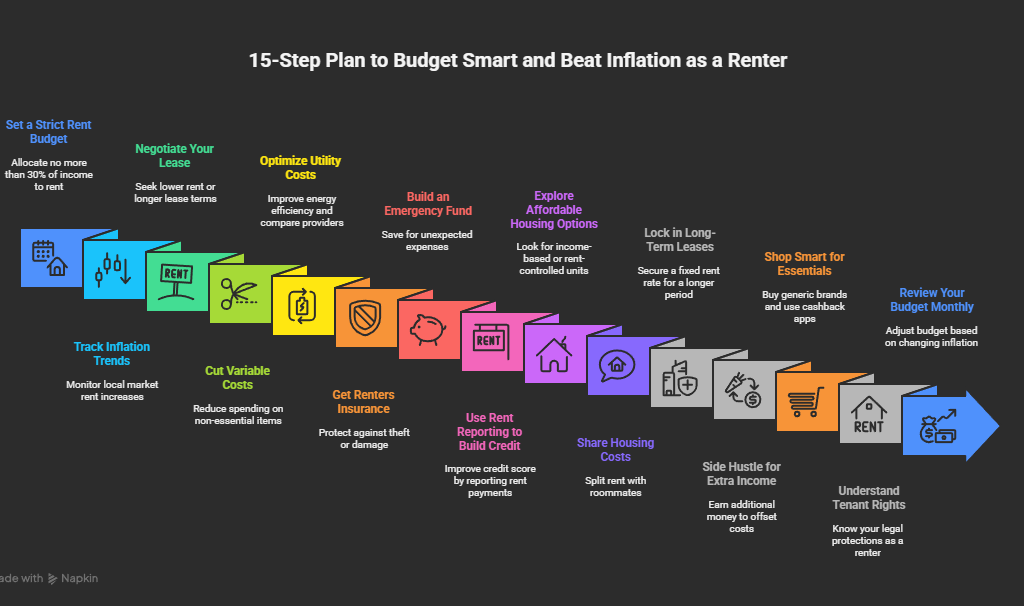
Step 1: Set a Strict Rent Budget
Spend no more than 30% of your gross income on rent, per HUD. If you earn $4,000/month, cap rent at $1,200.
- Include All Costs: Add utilities ($150-$300), renters insurance ($15-$22/month), and parking fees.
- Use Tools: Apartments.com’s rent calculator helps set limits.
- Mistake to Avoid: Renting above 30% leaves no buffer for inflation-driven hikes.
Step 2: Track Inflation Trends
Know your local market. Rent increases vary by city (e.g., Miami: 5.1%, per Zillow; Chicago: 3.8%).
- Check Data: Use ApartmentList.com for city-specific rent trends.
- Prepare for Hikes: Save 5% of rent monthly for potential increases.
Step 3: Negotiate Your Lease
Landlords may be flexible in 2025’s winter months (November-February).
- Ask For: Lower rent, waived fees, or a longer lease to lock in rates.
- Tip: Highlight your reliability or offer to prepay a month.
- Mistake to Avoid: Signing without negotiating, especially for vacant units.
Step 4: Cut Variable Costs
Variable costs like dining out or subscriptions eat your budget.
- Actions:
- Cook at home: Saves $200/month vs. takeout.
- Cancel unused subscriptions (Netflix, gym): Average savings $50/month.
- Shop sales: Buy groceries in bulk at Costco or Aldi.
- Tool: Use budgeting apps like Mint to track spending.
Step 5: Optimize Utility Costs
Utilities are rising 3-6%. Save by:
- Energy Efficiency: Use LED bulbs, unplug devices (saves $10/month).
- Compare Providers: Switch to cheaper internet or gas plans.
- Ask Landlords: Check if utilities are included to avoid surprises.
Step 6: Get Renters Insurance
At $15-$22/month, it protects against losses from theft or damage.
- Why It Helps: Saves money if disasters strike, avoiding out-of-pocket costs.
- Providers: Shop State Farm or Lemonade for quotes.
- Mistake to Avoid: Skipping insurance to “save” money—it’s a false economy.
Step 7: Build an Emergency Fund
Inflation makes emergencies costlier (average: $1,400, PYMNTS).
- Goal: Save 3-6 months of expenses ($3,600-$7,200 for $1,200 rent).
- How: Save $100/month in a high-yield savings account (4% APY, Ally Bank).
- Tip: Automate savings to stay consistent.
Step 8: Use Rent Reporting to Build Credit
Services like AxcessRent report rent to major credit bureaus, boosting your score.
- Impact: A $1,500/month rent payment reported for 6 months can raise your score by 20-50 points.
- Why It Matters: A 670+ score lowers loan rates, saving money on big purchases.
- Cost: $5-$10/month for AxcessRent.
Step 9: Explore Affordable Housing Options
Look for income-based or rent-controlled units.
- Resources: National Low Income Housing Coalition or HUD.gov.
- Example: In California, rent-controlled units cap increases at 5%.
- Mistake to Avoid: Ignoring local housing programs—you may qualify.
Step 10: Share Housing Costs
Roommates cut rent in half. A $1,800 apartment becomes $900/person.
- Find Roommates: Use Roommates.com or local Facebook groups.
- Tip: Screen for reliability to avoid conflicts.
- Savings: $500-$1,000/month in high-cost cities.
Step 11: Lock in Long-Term Leases
A 24-month lease protects against mid-term rent hikes.
- Benefit: If inflation drives rent up 5% ($75 on $1,500), you’re safe.
- Ask: Request a fixed-rate clause.
Step 12: Side Hustle for Extra Income
Wages lag inflation. A side gig adds cushion.
- Options: Drive for Uber, freelance on Upwork, or tutor ($15-$50/hour).
- Goal: Earn $200-$500/month to offset rising costs.
- Tip: Dedicate earnings to savings or rent.
Step 13: Shop Smart for Essentials
Groceries and household items are pricier in 2025.
- Buy Generic: Store brands save 20-30%.
- Use Apps: Ibotta or Fetch Rewards give cashback.
- Savings: $50-$100/month on food and supplies.
Step 14: Understand Tenant Rights
Know your state’s rent increase laws.
- Example: New York caps increases at 5% for rent-stabilized units.
- Resource: Check your state’s tenant handbook or fair housing agency.
- Mistake to Avoid: Not challenging illegal rent hikes.
Step 15: Review Your Budget Monthly
Inflation changes fast. Adjust your budget monthly.
- Steps: Track spending, cut one unnecessary expense, and save any surplus.
- Tool: YNAB (You Need A Budget) app helps plan.
How Inflation Affects First-Time Renters
Inflation in 2025 is hitting first-time renters hard, with the Renters Guide to Inflation spotlighting the unique challenges they face in a high-cost economy. With the Consumer Price Index (CPI) projected to rise 3-5% (Federal Reserve, 2025), everyday expenses like rent, utilities, and groceries are climbing faster than wages, which are growing at just 2.8% (BLS). For first-time renters—often young adults, recent graduates, or newcomers with limited financial experience—this creates a perfect storm of budgeting hurdles. Understanding these impacts is key to navigating the rental market successfully.
Key Challenges for First-Time Renters
- Higher Security Deposits Due to Low Credit Many first-time renters have thin credit files or scores below 580, making it tough to secure apartments. Landlords in competitive markets like New York or Miami often demand larger security deposits, ranging from $1,500 to $3,000, to offset perceived risks. Inflation exacerbates this by increasing the baseline rent, which directly raises deposit amounts. For example, a $1,800/month apartment may require a $3,600 deposit (two months’ rent), a steep upfront cost for someone just starting out.
- Stricter Landlord Approval Requirements Inflation pushes landlords to tighten income requirements. Most now expect your monthly income to be three times the rent. For a $1,500 apartment, you need $4,500/month or $54,000/year in income. With inflation outpacing wage growth, first-time renters may struggle to meet these thresholds, especially if they’re in entry-level jobs or gig work. Some landlords also require higher credit scores (650+), which many new renters lack.
- Unexpected Mid-Lease Cost Increases Inflation doesn’t just affect rent—it drives up utilities, maintenance fees, and other costs. Mid-lease utility hikes (3-6% annually, per Energy Information Administration) can add $10-$20/month to electric or gas bills. If your lease doesn’t cap these, you’re stuck paying more. Parking or amenity fees may also rise unexpectedly, straining budgets already stretched thin.
- Limited Savings for Emergencies First-time renters often have minimal savings—40% have less than $1,000, according to PYMNTS. Inflation makes it harder to save, as the cost of essentials like groceries (up 3.5%) and transportation (up 4%) eats into disposable income. An unexpected expense, like a $1,400 medical bill, can derail your ability to pay rent or cover move-in costs.
Strategies to Beat Inflation as a First-Time Renter
To overcome these challenges, the Renters Guide to Inflation recommends proactive steps tailored for first-time renters:
- Build Credit with Rent Reporting: Use services like AxcessRent to report rent payments to credit bureaus (Equifax, Experian, TransUnion). Consistent $1,500/month payments can boost your score by 20-50 points in six months, reducing deposit requirements and improving approval odds. A score of 670+ signals reliability to landlords.
- Save Early for Emergencies: Start small by setting aside $100/month in a high-yield savings account (e.g., 4% APY at Ally Bank). Over a year, this builds a $1,200 buffer for unexpected costs, protecting you from inflation-driven surprises like utility spikes.
- Research Low-Growth Rental Markets: Choose cities with slower rent increases to stretch your budget. For example, Atlanta’s rent growth is 2.9% compared to Miami’s 5.1% (Zillow, 2025). Use ApartmentList.com to compare markets and find affordable options. Smaller cities or suburbs often have lower costs and less competition.
- Negotiate Lease Terms: In less competitive months (November-February), ask for lower rent or waived fees. Highlight your on-time payment history or offer to prepay a month to secure better terms, shielding you from inflation-driven hikes.
- Consider Roommates: Splitting a $1,800 apartment with a roommate cuts your share to $900, saving $10,800 annually. Use platforms like Roommates.com to find compatible matches, easing the financial burden of rising costs.
These strategies empower first-time renters to tackle inflation’s challenges head-on, ensuring they can secure a lease and maintain financial stability in 2025’s tough economy.
Common Mistakes to Avoid in an Inflationary Economy
Inflation makes every dollar count, and first-time renters can’t afford missteps. The Renters Guide to Inflation highlights five critical mistakes to avoid when renting in 2025’s high-cost environment. Steering clear of these pitfalls saves money and reduces stress, helping you beat inflation while renting.
- Over-Renting Beyond Your Means Spending more than 30% of your gross income on rent is a trap. If you earn $4,000/month, keep rent below $1,200. Inflation raises costs for utilities and groceries, so over-renting leaves no room for these. For example, a $1,500 apartment on a $4,000 income eats 37.5% of your budget, risking missed payments if prices rise further. Fix: Use a rent affordability calculator on Apartments.com and stick to the 30% rule.
- Ignoring Potential Rent Increases Many renters don’t plan for mid-lease or renewal rent hikes, which average 4.2% in 2025 (Apartment List). A $1,500 apartment could jump to $1,563, adding $756/year. Without savings, this can force you to move or cut essentials. Fix: Save 5% of your rent monthly ($75 for a $1,500 apartment) in a dedicated account to cover increases.
- Skipping Renters Insurance Renters insurance, at $15-$22/month, protects against theft, fire, or water damage. Yet, many skip it to “save” money. Inflation raises repair costs—a $500 damaged laptop could cost $525 in 2025. Without insurance, you pay out of pocket. Fix: Shop affordable policies from State Farm or Lemonade. It’s a small price for big protection.
- Not Negotiating Lease Terms Inflation makes landlords less flexible, but you can still negotiate, especially in winter (November-February). Failing to ask for lower rent, waived fees, or a fixed-rate lease means paying more. For example, negotiating a $50/month discount on a $1,500 apartment saves $600/year. Fix: Highlight your reliability (e.g., steady job) or offer to sign a longer lease for better terms.
- Forgetting to Budget for Utility Increases Utilities like electricity and gas are rising 3-6% annually. A $150/month electric bill could hit $159-$162, adding $108-$144/year. Many renters budget only for rent, ignoring these hikes. Fix: Include utilities in your budget and use energy-saving tips like LED bulbs or unplugging devices to save $10-$20/month.
Avoiding these mistakes ensures you stay financially secure, even as inflation drives up living costs for first-time renters.
Tools and Resources for Renters in 2025
Navigating inflation as a renter is easier with the right tools. The Renters Guide to Inflation recommends these resources to help first-time renters budget smart, save money, and beat inflation in 2025. Each tool is practical, affordable, and tailored to renters’ needs.
- AxcessRent: This platform reports your rent payments to credit bureaus (Equifax, Experian, TransUnion), boosting your credit score. A $1,500/month rent payment reported for six months can raise your score by 20-50 points, helping you qualify for better leases or loans. Costs $5-$10/month, a small price for credit-building in an inflationary economy. Visit AxcessRent to start.
- Mint or YNAB (You Need A Budget): These budgeting apps track spending and help you stick to the 30% rent rule. Mint is free, while YNAB costs $14.99/month but offers detailed planning. Both sync with bank accounts to monitor rent, utilities, and variable costs like groceries, saving you $50-$100/month by cutting waste.
- ApartmentList.com: This site provides city-specific rent trend data, crucial for first-time renters facing inflation. For example, check if Atlanta (2.9% rent growth) is more affordable than Miami (5.1%). It also lists rentals with filters for budget and amenities, helping you find deals in high-cost markets.
- HUD.gov: The U.S. Department of Housing and Urban Development offers resources for affordable housing. Programs like Section 8 or income-based rentals cap costs for low-income renters, shielding you from inflation’s impact. Check eligibility and local options to save hundreds monthly.
- Ibotta: This cashback app rewards you for grocery and household purchases. With food prices up 3.5%, Ibotta can save $10-$30/month by scanning receipts from stores like Walmart or Aldi. It’s free and easy to use, stretching your budget further.
- AnnualCreditReport.com: Access free credit reports from all three bureaus to verify rent reporting and check for errors. A clean report with reported rent payments (via AxcessRent) strengthens your financial profile, helping you secure leases despite inflation-driven landlord scrutiny.
These tools empower renters to manage costs, build credit, and stay ahead of inflation’s 3-5% price hikes in 2025.
Conclusion
Inflation in 2025 is making renting tougher, especially for first-time renters facing 3-5% price increases in rent, utilities, and essentials. But the Renters Guide to Inflation shows you can thrive with smart strategies. Follow the 15-step plan: cap rent at 30% of income, cut variable costs like dining out, negotiate leases, and use AxcessRent to report rent payments and build credit. Save for emergencies, explore affordable housing, and use apps like Mint or Ibotta to stretch your budget. Avoid mistakes like over-renting or skipping insurance to stay financially secure. With inflation driving up costs, preparation is everything. Start today by checking rent trends on ApartmentList.com and signing up for AxcessRent to boost your credit and beat inflation. Rent confidently and take control of your financial future in 2025.cking rent trends on ApartmentList.com and signing up for AxcessRent. Beat inflation and rent confidently. Visit AxcessRent for more tips.
FAQs for Renters Facing Inflation in 2025
How Does Inflation Affect Renters in 2025?
Inflation raises rent (4.2% average), utilities (3-6%), and groceries (3.5%). First-time renters need higher income or deposits to get approved. Budgeting and cost-cutting are key.
How Can First-Time Renters Beat Inflation?
Set a 30% rent budget, negotiate leases, share costs with roommates, and report rent via AxcessRent to build credit. Save $100/month for emergencies.
What Are the Best Budgeting Tips for Renters in 2025?
Cap rent at 30% of income, cut subscriptions, buy generic groceries, and use apps like Mint. Save 5% of rent for hikes and get renters insurance.
How Can Rent Reporting Help During Inflation?
Services like AxcessRent report rent to bureaus, raising your credit score. A 670+ score lowers loan rates, saving money as costs rise.
Should I Get a Long-Term Lease to Beat Inflation?
Yes. A 24-month lease locks in rent, protecting against 3-5% hikes. Ask for a fixed-rate clause.
How Do I Find Affordable Rentals During Inflation?
Use Apartments.com or Zillow, filter by price, and check HUD.gov for income-based units. Consider roommates to split costs.