Late Rent Notice: Download Free printable PDF Template
Late rent payments are a common challenge for landlords and tenants alike. Whether it’s a simple oversight or a financial hiccup, addressing overdue rent promptly and professionally is crucial to maintaining a healthy landlord-tenant relationship while protecting your legal rights. A late rent notice is your first step in this process, serving as a formal reminder to tenants about unpaid rent and setting the stage for resolution or further action.
In this comprehensive guide, we’ll explore what a late rent notice is, how to write one, state-specific rules (like California and Texas), and provide a free printable late rent notice template in PDF and Word formats. We’ll also answer popular questions like “How to write a late rent notice?” and “What’s the longest you can be late on rent?”. Let’s get started.
What is a Late Rent Notice?
A late rent notice, also known as a Notice to Pay Rent, Failure to Pay Rent Notice, Demand for Payment, or Notice to Cure, is a written document from a landlord to a tenant notifying them that their rent payment is overdue. It’s not an eviction notice but a formal step to prompt payment, document the issue, and prevent escalation to legal action like eviction. The notice serves three key purposes:
- Formal Notification: Alerts tenants to their overdue rent and any applicable late fees.
- Legal Documentation: Creates a record of communication, which is critical if the issue escalates to court.
- Encourages Payment: Motivates tenants to settle the outstanding balance before further consequences, like eviction proceedings.
Late rent notices are typically issued after the rent due date or any grace period outlined in the lease or required by state law (usually 2–5 days). For example, a tenant might simply forget to pay, and a notice acts as a friendly nudge. However, it also sets a clear deadline and outlines consequences, ensuring both parties are on the same page.
Why is a Late Rent Notice Important?
- Enforces Lease Terms: Reinforces the payment schedule agreed upon in the lease.
- Prevents Escalation: Encourages timely payment to avoid eviction or legal disputes.
- Protects Landlords: Provides proof of communication if the matter goes to court.
- Maintains Professionalism: Keeps interactions clear and documented, fostering trust.
What to Include in a Late Rent Notice
A well-crafted late rent notice should be clear, professional, and legally compliant. Here’s what to include:
- Date of Notice: The date the notice is issued, serving as a legal timestamp.
- Tenant’s Name and Address: Full name(s) of the tenant(s) and the rental property address, including unit number if applicable.
- Overdue Rent Amount: The exact amount of unpaid rent, including any prior unpaid balances.
- Late Fees: Any applicable fees as outlined in the lease agreement.
- Payment Deadline: A specific date by which the tenant must pay to avoid further action.
- Consequences of Non-Payment: A brief mention of next steps, such as eviction proceedings, if the payment isn’t made.
- Landlord’s Contact Information: Phone number or email for the tenant to reach out with questions or payment arrangements.
- Delivery Method: Note how the notice is delivered (e.g., certified mail, in-person) for legal documentation.
Free Late Rent Notice Template (PDF & Word)
To make things easy, we’ve created a customizable late rent notice template available in PDF and Word formats. This template is designed to be professional, compliant with general legal standards, and easy to tailor to your state’s requirements.
[Your Name or Property Management Company]
[Your Address]
[City, State, ZIP Code]
[Date]
[Tenant’s Name]
[Property Address]
[City, State, ZIP Code]
Dear [Tenant’s Name],
Subject: Notice of Late Rent Payment
This letter serves as formal notice that the rent payment for [Property Address] is past due. As of [Due Date], the monthly rent of $[Rent Amount] remains unpaid, exceeding the grace period outlined in your lease agreement.
You are responsible for the following:
- Unpaid Rent: $[Rent Amount]
- Late Fees (per lease agreement): $[Late Fee Amount]
- Total Amount Owed: $[Total Amount]
Please remit the full amount by [Payment Deadline] to avoid further action, which may include legal proceedings or eviction as permitted by [State] law. If you have already paid, please disregard this notice.
How to Write a Late Rent Notice: Step-by-Step Guide
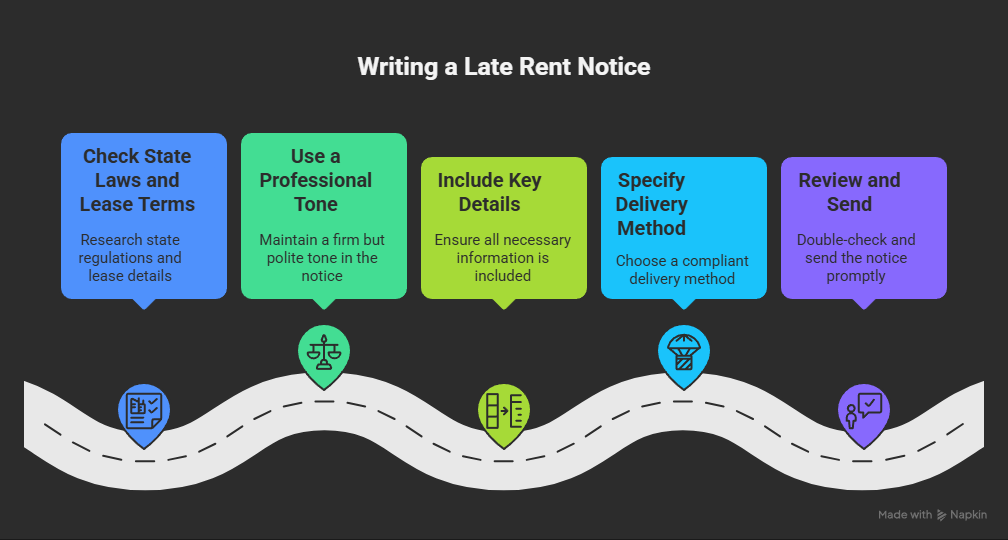
Writing a late rent notice doesn’t have to be complicated, but it should be clear, professional, and legally sound. Follow these steps to create an effective notice:
Step 1: Check State Laws and Lease Terms
Before drafting, research your state’s regulations on late rent notices, grace periods, and delivery methods. For example:
- California: Allows notices immediately after rent is due, with a 3-day grace period for eviction notices.
- Texas: Requires a 3-day grace period before a notice to vacate can be issued.
- New York: Mandates a written notice if rent is more than 5 days late, delivered by certified mail.
Also, review the lease agreement for due dates, grace periods, and late fee policies.
Step 2: Use a Professional Tone
Keep the tone firm but polite. A friendly approach can encourage payment without escalating tension, especially for first-time offenders. For repeat issues, a sterner tone may be appropriate.
Step 3: Include Key Details
Use the structure from the template above, ensuring all required elements (tenant name, overdue amount, deadline, etc.) are included. Be specific about amounts and dates to avoid confusion.
Step 4: Specify Delivery Method
Choose a delivery method that complies with state law:
- Certified Mail: Provides proof of receipt (recommended).
- In-Person: Ensures direct delivery but may require a signed acknowledgment.
- Email: Allowed in some states if the lease permits, but confirm receipt.
- Posting on Property: Permitted in some states if the notice is clearly visible (e.g., taped to the door).
Always retain proof of delivery, like a certified mail receipt or email confirmation.
Step 5: Review and Send
Double-check the notice for accuracy and compliance. Send it promptly after the grace period (if any) to show you’re serious about enforcing lease terms. Keep a copy for your records.
Sample Late Rent Notice Letters
Here are three variations of late rent notices, tailored to different scenarios:
1. Friendly Reminder Notice
For first-time or minor delays, a gentle tone can maintain goodwill.
Sample:
[Date]
[Tenant’s Name] [
Property Address]
Dear [Tenant’s Name],
This is a reminder that your rent payment of $[Rent Amount] for [Month] at [Property Address] is overdue as of [Due Date]. Per your lease, a late fee of $[Late Fee Amount] applies, bringing the total to $[Total Amount].
Please submit payment by [Payment Deadline] to avoid further action. Contact me at [Your Phone Number] if you need to discuss options.
Sincerely, [Landlord Name]
2. Firm Overdue Notice
For tenants who’ve been reminded before or have a history of late payments.
Sample:
[Date]
[Tenant’s Name]
[Property Address]
Dear [Tenant’s Name],
This notice regards your overdue rent for [Month] at [Property Address]. Your payment of $[Rent Amount] remains unpaid, and a late fee of $[Late Fee Amount] has been applied, totaling $[Total Amount].
Payment is due by [Payment Deadline]. Failure to pay may lead to legal action, including eviction proceedings. Contact me at [Your Phone Number] immediately to resolve this.
Sincerely, [Landlord Name]
3. Final Past Due Notice
For serious cases where eviction is the next step.
Sample:
[Date]
[Tenant’s Name]
[Property Address]
Dear [Tenant’s Name],
This is a final notice for your unpaid rent for [Month] at [Property Address]. Your balance of $[Total Amount], including $[Late Fee Amount] in fees, is past due.
If payment is not received by [Final Deadline], I will initiate eviction proceedings per [State] law. Contact me at [Your Phone Number] to resolve this matter urgently.
Sincerely, [Landlord Name]
State-Specific Late Rent Notice Requirements
Late rent notice rules vary by state. Below are key regulations for California and Texas, along with general guidelines:
California rent late notice
- Grace Period: No mandatory grace period, but leases may specify one (typically 3–5 days).
- Notice Requirements: Notices must be written and delivered via certified mail, in-person, or posted on the property.
- Late Fees: Must be “reasonable” (often ~5% of monthly rent) and outlined in the lease.
- Eviction Process: A 3-day “Pay or Quit” notice can be issued after a late rent notice if payment isn’t made.
- Notes: Accepting partial payments may restart the eviction timeline.
Texas rent late notice
- Grace Period: Minimum 3-day grace period before a notice to vacate can be issued.
- Notice Requirements: Written notice via certified mail, in-person, or posted on the property.
- Late Fees: Capped at 12% of monthly rent for properties with four or fewer units, 10% for larger properties.
- Eviction Process: A 3-day notice to vacate follows a late rent notice if unpaid.
- Notes: Landlords can offer a monthly fee instead of a security deposit, which may affect late payment disputes.
General Guidelines
- New York: Requires a written notice if rent is 5+ days late, delivered by certified mail.
- Florida: No mandatory grace period, but multiple notices may be required before eviction.
- Virginia: Caps late fees at 10% of monthly rent or the remaining balance after a 5-day grace period.
Always consult your state’s housing authority or an attorney to ensure compliance. Resources like Nolo.com or local landlord associations can provide detailed regulations.
When should i send out late rent notice?
Sending a late rent notice correctly is critical for legal protection. Common delivery methods include:
- Certified Mail: Offers proof of receipt and is often required by law.
- In-Person Delivery: Ensure the tenant signs an acknowledgment.
- Email: Allowed in some states if the lease permits, but confirm receipt.
- Posting on Property: Tape the notice to the tenant’s door if state law allows.
Keep copies of the notice and proof of delivery (e.g., certified mail receipt, email confirmation, or signed acknowledgment). Include the issuance date to prove compliance with notice periods.
When to Send a Late Rent Notice
Timing depends on your lease and state laws:
- After Late Payment: Send as soon as rent is overdue, unless a grace period applies.
- After Grace Period: If your lease or state law includes a grace period (e.g., 2–5 days), send the notice immediately after it ends.
- After Partial Payment: Issue a notice for the remaining balance if the tenant pays less than the full amount.
For example:
- Texas: Wait 3 days after the due date before issuing a notice to vacate.
- California: Send a notice immediately if no grace period is specified in the lease.
Check local regulations to avoid premature or delayed notices, which could weaken your legal standing.
What is a Reasonable Late Fee?
Late fees must be “reasonable” and comply with state laws. Common caps include:
- California: ~5% of monthly rent, as a reasonable estimate of costs incurred.
- Florida: $20 or 20% of monthly rent, whichever is greater.
- Texas: 12% for small properties (≤4 units), 10% for larger ones.
- Virginia: 10% of monthly rent or remaining balance after a 5-day grace period.
High fees can discourage tenants from renewing leases or lead to disputes. Ensure fees are clearly outlined in the lease and align with local regulations.
How to Avoid Late Rent Payments
Preventing late rent is better than chasing it. Here are practical tips:
- Screen Tenants Thoroughly: Use tenant screening services to verify income, credit, and rental history.
- Set Clear Lease Terms: Specify due dates, grace periods, and late fees in the lease.
- Automate Rent Collection: Tools like Baselane send reminders and apply late fees automatically.
- Offer Flexible Payments: Allow ACH, credit/debit card, or online payments to make paying easier.
- Communicate Openly: Encourage tenants to discuss payment issues early to find solutions.
Late Rent Notice vs. 3-Day Pay or Quit Notice: What’s the Difference?
- Late Rent Notice: A reminder to pay overdue rent, often with a deadline and late fees. It’s a preliminary step to resolve the issue.
- 3-Day Pay or Quit Notice: A formal legal notice requiring tenants to pay the full amount or vacate within 3 days. It’s a precursor to eviction proceedings in many states.
Using the correct notice is critical to avoid legal missteps. Download our free late rent notice template to ensure you start with the right document.
Conclusion
A late rent notice is a critical tool for landlords to address overdue rent professionally and legally. By including key details, following state laws (like those in California and Texas), and using a clear, firm tone, you can encourage timely payments and protect your rights. Our free late rent notice template in PDF and Word formats simplifies the process, while tools like Baselane can prevent late payments through automated reminders and flexible payment options. For tenants, understanding these notices can help avoid escalation and maintain a good rental history. Whether you’re searching for a late rent notice template pdf free or tips to avoid late rent, this guide has you covered.
FAQs About Late Rent Notices
How to Write a Late Rent Notice?
To write a late rent notice:
- Include the date, tenant’s name, and property address.
- Specify the overdue rent amount, late fees, and total owed.
- Set a clear payment deadline.
- Outline consequences of non-payment (e.g., eviction).
- Provide your contact information.
- Use a professional tone and comply with state laws. Download our free printable late rent notice template for a customizable starting point.
What’s the Longest You Can Be Late on Rent?
The time before consequences depends on your lease and state laws:
- Grace Periods: Typically 2–5 days (e.g., 5 days in Virginia, 15 days in Maine).
- Notice Periods: After a late rent notice, states like California and Texas allow a 3-day “Pay or Quit” notice if unpaid, leading to eviction if unresolved.
- Eviction Timeline: Varies (7–30 days after a pay-or-quit notice, depending on state). Check your lease and local laws to understand the exact timeline.
What If a Tenant Doesn’t Give a 30-Day Notice?
If a tenant leaves without providing the required 30-day notice (common for month-to-month leases), they may be liable for:
- The next month’s rent or a penalty fee, as outlined in the lease.
- Costs for re-renting the property (e.g., advertising). Send a written notice demanding payment, citing the lease terms. If unpaid, pursue recovery through small claims court or deduct from the security deposit (if allowed by state law).
Can You Evict Tenants for Paying Rent Late?
Yes, most states allow eviction for non-payment of rent, but the process varies:
- Send a late rent notice first, followed by a “Pay or Quit” notice (e.g., 3 days in California).
- If unpaid, file for eviction with the local court.
- Accepting partial payments may reset the eviction timeline in some states, so check local laws.
Can Landlords Charge a Late Rent Fee?
Yes, if the lease specifies late fees and they comply with state caps (e.g., 5% in California, 10–12% in Texas). Fees must be reasonable and documented in the lease. Use tools like Baselane to automate fee application and tracking.
What If Tenants Refuse to Pay Late Fees?
If tenants refuse late fees:
- Confirm the fees are in the lease and comply with state law.
- Send a late rent notice including the fees and a payment deadline.
- If unpaid, consider legal action or eviction, but verify local regulations first.
Steps in an Eviction for Non-Payment of Rent
- Issue a Late Rent Notice: Notify the tenant of overdue rent and fees.
- Send a Pay or Quit Notice: Typically 3–5 days to pay or vacate (varies by state).
- File for Eviction: Submit paperwork to the local court if the tenant doesn’t pay or leave.
- Court Hearing: Present evidence of non-payment; the tenant can respond.
- Eviction Order: If approved, a sheriff enforces the tenant’s removal.