Why Does Everything in Adult Life Require a Credit Score?
Your credit score is now the main way companies predict if you’ll pay bills on time. It started with loans and cards but spread everywhere because it’s cheap, fast, and automated. Landlords, employers, utilities, and insurers use it to lower their risk — even if it feels unfair.
When Did Credit Scores Start Controlling Everything?
| Year | What Happened | New Use Beyond Loans/Cards |
|---|---|---|
| 1950s–80s | FICO score invented (1989) | Mostly lending |
| 1990s | Internet + data explosion | Apartments start checking |
| 2000s | Background check companies add scores | Jobs, insurance |
| 2010s | Gig economy + apps need instant decisions | Phone plans, utilities |
| 2020–2025 | AI risk models + economic uncertainty | Dating apps, subscriptions, even some retail credit |
Now 90%+ of landlords and most big employers run credit checks.
What Adult Things Check Your Credit Score Today?
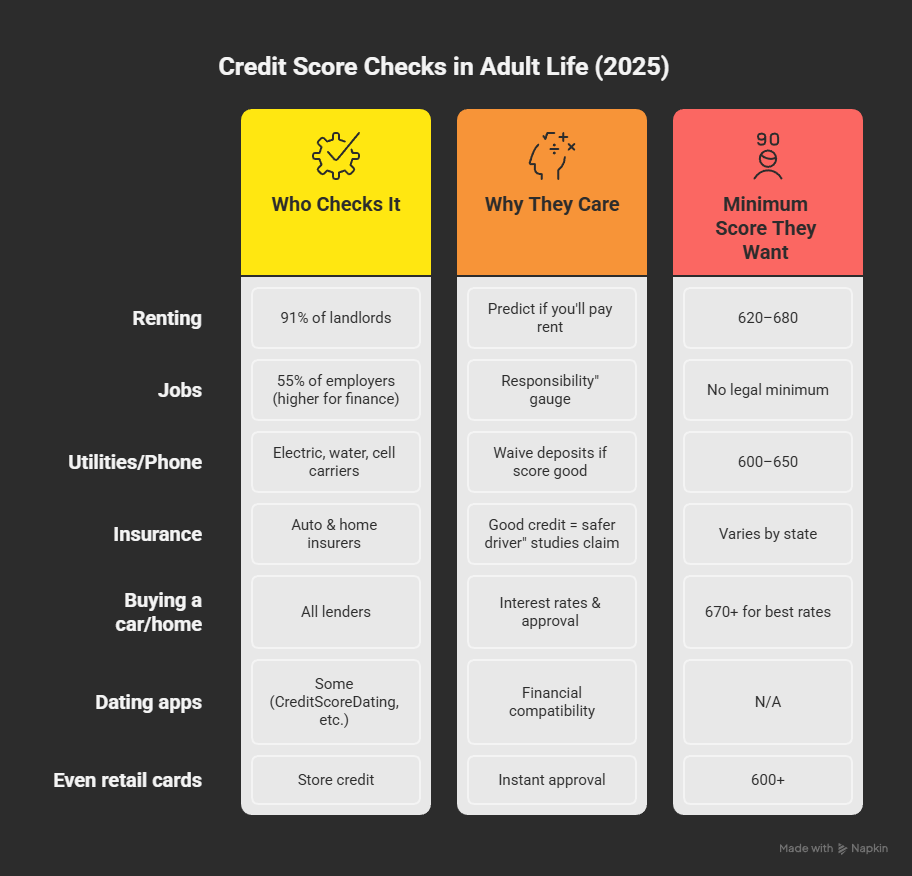
| Category | Who Checks It | Why They Care | Minimum Score They Want |
|---|---|---|---|
| Renting | 91% of landlords | Predict if you’ll pay rent | 620–680 |
| Jobs | 55% of employers (higher for finance) | “Responsibility” gauge | No legal minimum |
| Utilities/Phone | Electric, water, cell carriers | Waive deposits if score good | 600–650 |
| Insurance | Auto & home insurers | “Good credit = safer driver” studies claim | Varies by state |
| Buying a car/home | All lenders | Interest rates & approval | 670+ for best rates |
| Dating apps | Some (CreditScoreDating, etc.) | “Financial compatibility” | N/A |
| Even retail cards | Store credit | Instant approval | 600+ |
Why? A 100-point higher score can save $10K–$100K+ in interest and deposits over life.
Is It Legal for Everyone to Check Your Credit?
- Landlords & lenders: Yes
- Employers: Yes in most states (banned in CA, NY, IL, etc. for non-finance jobs)
- Insurance: Allowed in 47 states
- Utilities: Yes, soft inquiry usually
They must get permission (you sign for it).
Why Did This Happen So Fast?
- Cheap data — credit reports cost companies pennies.
- Automation — no human review needed.
- Lawsuits — companies fear “negligent hiring” or unpaid bills.
- Profit — people with lower scores pay higher deposits/rates.
Result: bad score = higher life costs even if you pay cash.
How to Fight Back or Build Score Without Traditional Credit
| Method | How It Helps | Avg Boost |
|---|---|---|
| Report rent payments | Adds your biggest bill as positive history | 20–60 pts |
| Secured credit cards | Builds payment history safely | 30–100 pts |
| Authorized user on good card | Piggybacks parent’s/spouse history | 20–80 pts |
| Credit-builder loans | Forces on-time payments | 30–70 pts |
| Experian Boost (free) | Adds Netflix, phone bills | 13–20 pts |
Services like AxcessRent rent reporting work even with past evictions or thin files.
Facts
- 1 in 3 renters denied in 2025 due to credit below 620 (Zillow)
- Average deposit waived with 700+ score: $200–$1,500 saved per move
- Employers reject 16% of applicants after credit check (SHRM 2025)
- Rent reporting users qualify for apartments faster (AxcessRent data)
FAQ
Why do landlords check credit scores now?
They predict rent payment risk. Low score = higher deposit or denial.
Do jobs really look at credit scores?
Yes in 2025? 55% do. Finance, government, management roles almost always.
Why do phone companies want good credit?
To skip $200–$500 deposits on new lines.
Can I rent an apartment with bad credit?
Yes — higher deposit, cosigner, or prove on-time rent with AxcessRent reporting.
Why do insurance companies use credit scores?
They claim good credit = fewer claims. Can raise premiums 50–200%.
Is it legal to deny jobs over credit?
Yes in most states. No in 11 states + some cities.
Why did credit scores spread to everything?
Cheap data + automation + risk reduction for companies.
How much money do I lose with bad credit?
$200K+ lifetime in higher rates and deposits (Urban Institute).
Does everyone need perfect credit?
No. 650–700 is enough for most things.
How fast can I raise my score for renting?
30–90 days with rent reporting and on-time payments.