What is Zero-Based Budgeting? Complete Implementation Manual
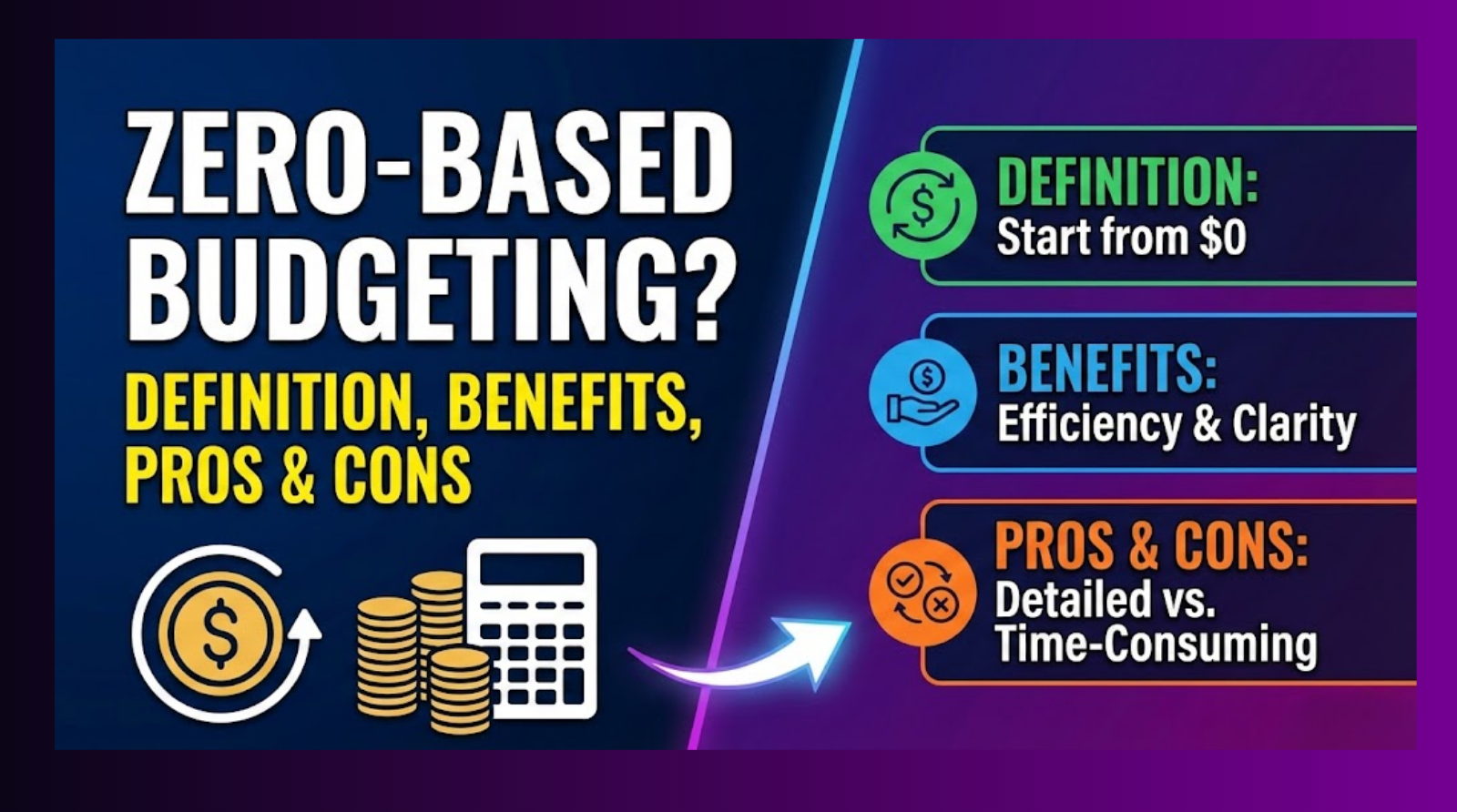
In traditional budgeting, many organizations simply take last year’s spending and add a small percentage for inflation. Zero-Based Budgeting (ZBB) flips this script entirely. It is a rigorous financial strategy where every single expense must be justified for each new period, starting from a “zero base.”
Whether you are a corporate finance professional or an individual looking to master personal finance, understanding ZBB is critical for eliminating waste and maximizing efficiency.
What is a Zero-Based Budget?
A zero-based budget is a method of budgeting where your total income minus your total expenses equals zero. Unlike traditional budgeting, which uses historical data as a baseline, ZBB ignores what was spent in the past.
In a ZBB environment, the budget starts at $0.00 at the beginning of every month or fiscal year. Every department (in a company) or every dollar (in a household) is assigned a specific job. If a line item cannot be justified as essential or value-adding, it receives no funding.
What Makes a Budget a “Zero-Based” Budget?
The defining characteristic of a zero-based budget is intentionality. It is not a zero-based budget unless:
- The Base is Zero: You do not carry over previous budget totals automatically.
- Every Dollar is Assigned: Every cent of income is allocated to a category (savings, expenses, or debt repayment).
- Justification is Mandatory: Every expense is scrutinized for its necessity and its Return on Investment (ROI).
Why is Zero-Based Budgeting the Most Effective?
Many financial experts consider ZBB the most effective budgeting type because it creates radical transparency. Here is why it outperforms traditional methods:
- Elimination of “Budget Padding”: In traditional budgets, managers often overstate needs to ensure they don’t lose funding next year. ZBB eliminates this “use it or lose it” mentality.
- Alignment with Strategy: Since you have to justify every expense, the money naturally flows toward the projects and goals that matter most right now, rather than what mattered five years ago.
- Maximum Efficiency: It identifies “zombie projects”—activities that continue to receive funding simply because they always have, despite no longer being useful.
- Variable Cost Control: It is highly responsive to changes in the economic environment, allowing users to pivot spending quickly.
Zero-Based Budgeting Example
To understand how ZBB works in practice, let’s look at a simple monthly household example.
Total Monthly Income: $5,000
| Category | Allocation | Justification |
|---|---|---|
| Housing/Utilities | $1,800 | Essential living requirement. |
| Groceries | $600 | Calculated based on current meal planning. |
| Transportation | $400 | Fuel and maintenance for work commute. |
| Emergency Fund | $1,000 | Priority goal: Building 6 months of runway. |
| Retirement (401k) | $700 | Standard monthly contribution. |
| Entertainment | $300 | Discretionary spending for quality of life. |
| Debt Paydown | $200 | Accelerated payment on credit card. |
| Total Expenses | $5,000 | |
| Remaining Balance | $0 |
In this example, the budgeter has accounted for every cent. If they want to spend $100 more on entertainment, they must take that $100 from another category, like debt paydown or groceries.
Top 4 Drawbacks of Zero-Based Budgeting
While highly effective, ZBB is not without its challenges. What might one drawback of this method be? The most significant disadvantage is that it is extremely time-consuming.
- Administrative Burden: Requiring justification for every expense requires massive amounts of data and meetings. In a large corporation, this can take thousands of man-hours.
- Short-Term Focus: Because the budget is built from scratch frequently, there is a risk that managers will prioritize immediate needs over long-term, multi-year strategic investments.
- Resource Intensiveness: Smaller companies or busy individuals may find the “overhead” of managing the budget more costly than the savings the budget actually generates.
- Cultural Resistance: Employees may feel micromanaged or distrusted when they have to defend every dollar of their operational costs every year.
Zero-Based Budgeting: Advantages and Disadvantages
Advantages:
- Accuracy: Matches spending to current needs.
- Cost Reduction: Identifies and cuts wasteful spending.
- Engagement: Forces managers and individuals to understand their finances deeply.
Disadvantages:
- Complexity: Harder to implement than “last year + 5%.”
- Slow Pace: Can delay operational decisions due to the justification process.
- Potential for Friction: Can cause conflict between departments competing for the same “zeroed” pool of funds.
Deep Dive: The Evolution of ZBB in Modern Finance
Originally developed by Peter Pyhrr at Texas Instruments in the 1960s, ZBB gained massive popularity when it was adopted by the Carter administration for federal budgeting. In the modern era, private equity firms—most notably 3G Capital—have used ZBB to turn around struggling companies like Kraft Heinz and Anheuser-Busch InBev.
In today’s digital economy, ZBB has evolved from a manual spreadsheet nightmare into a dynamic process powered by AI and cloud-based financial planning and analysis (FP&A) software. This technology reduces the “time-consuming” drawback by automating data collection and categorizing expenses in real-time.
ZBB vs. Incremental Budgeting: A Direct Comparison
While ZBB starts at zero, Incremental Budgeting takes the previous period’s actual results and adds or subtracts a percentage to get the new budget.
- Focus: Incremental budgeting focuses on “changes.” ZBB focuses on “everything.”
- Risk: Incremental budgeting risks carrying over inefficiencies indefinitely. ZBB risks being too rigid for fast-moving environments.
- Effort: Incremental is low effort; ZBB is high effort.
How to Implement Zero-Based Budgeting: Step-by-Step
Implementing ZBB is a cultural shift as much as a financial one. Whether for a company or a family, follow these steps:
1. Identify “Decision Units”
Break the organization down into its smallest functional parts. For a household, this is your categories (Food, Rent, Hobby). For a corporation, this might be the “Northeast Marketing Team” or “R&D Lab 4.”
2. Analysis of the Decision Package
For every decision unit, analyze what it does, why it does it, and what the cost is. Ask: “What would happen if we didn’t fund this at all?” and “Is there a cheaper way to achieve the same result?”
3. Ranking and Prioritizing
This is the most critical stage. Once all “packages” are justified, rank them from most essential to least essential. You fund the top-tier priorities first. When the money runs out, the remaining packages go unfunded.
4. Continuous Monitoring
ZBB is not a “set it and forget it” system. Because every dollar is assigned, any variance in actual spending must be addressed immediately to keep the budget at zero.

The Psychology of Zero-Based Budgeting
Why does ZBB work so well for individuals? It leverages the Scarcity Mindset in a productive way. When you look at your bank account and see $5,000, you feel “rich.” When you look at your Zero-Based Budget and see that $4,950 is already “spent” on obligations (even if those obligations are savings), you feel a healthy sense of constraint.
This prevents “lifestyle creep”—the phenomenon where your spending rises to meet your income. ZBB forces you to decide that your future retirement is more important than a new gadget today, because you are forced to make that trade-off on paper before the money leaves your hand.
Common Myths About ZBB
- Myth 1: “It means you have zero dollars in the bank.” No. It means you have zero unassigned dollars. Your bank account should ideally be quite full, but every dollar has a name on it.
- Myth 2: “It’s only for companies in trouble.” While ZBB is a great turnaround tool, healthy companies use it to maintain their competitive edge and prevent bloat during profitable years.
- Myth 3: “You have to do it every single month.” While monthly is best for individuals, many corporations perform a “Deep Dive ZBB” every 3 years and use modified versions in the interim.
Conclusion
Zero-based budgeting is the gold standard for financial discipline. It is a powerful tool for anyone looking to optimize their financial health. By starting at zero and justifying every expense, you ensure that your money is working as hard as possible. While the time commitment is high, the reward is a lean, efficient, and strategically aligned financial plan that prioritizes growth over habit.
Frequently Asked Questions (FAQs)
What is the main difference between traditional and zero-based budgeting?
The main difference is the starting point. Traditional budgeting starts with last year’s figures and adjusts them. Zero-based budgeting starts at zero and requires every single expense to be justified from scratch.
Is zero-based budgeting good for beginners?
Yes, it is excellent for beginners because it provides a clear roadmap for where every dollar goes. However, it requires more discipline than simpler methods like the 50/30/20 rule.
How often should I update a zero-based budget?
For personal finance, it should be updated monthly before the new month begins. For businesses, the full process is usually done annually, with monthly reviews of variances.
Can ZBB be used for variable income?
Absolutely. If your income varies, ZBB is actually safer. You create a “priority list” of expenses. As the money comes in, you fund the items from top to bottom. If you have a low-income month, you simply stop funding the items at the bottom of the list.
Does ZBB work for large corporations?
Yes. Many Fortune 500 companies use ZBB to find billions in savings. However, it requires specialized software and a dedicated finance team to handle the administrative load.
What happens if I overspend in a ZBB category?
In a zero-based budget, if you overspend in one category, you must “balance the scales” by reducing another category. If you spend $50 extra on gas, you must take $50 out of your dining out or clothing budget to ensure the total remains at zero.