
What Is Rent Seeking? Shocking Examples and Its Hidden Economic Costs
Rent seeking is a foundational yet often misunderstood concept in economics and political science. At its core, it refers to efforts by individuals, corporations, or interest groups to increase their wealth without producing new value or contributing to the economy’s growth.
Rather than earning profits through innovation, entrepreneurship, or improved services, rent seekers exploit existing systems—economic, legal, or political—to extract unearned benefits. These benefits often come in the form of government subsidies, regulatory protections, tax loopholes, or exclusive rights that limit competition or shift wealth toward the rent seeker.
For instance, a company might spend millions lobbying for regulations that create barriers for new competitors—not to offer a better product, but simply to maintain control and maximize profits without adding any value to consumers or society.
What Is Rent Seeking?
Rent seeking occurs when an individual, company, or organization seeks to gain financial benefits by influencing economic policies or legal frameworks rather than by engaging in productive activities. The term “rent” here does not refer to leasing property but rather to unearned income acquired through manipulation rather than innovation or labor.
Key Characteristics of Rent Seeking:
- Wealth Redistribution, Not Creation: Rent seekers aim to capture a larger share of existing wealth rather than generate new value.
- Political and Regulatory Manipulation: Often involves lobbying, subsidies, tariffs, or regulatory changes that favor certain groups.
- Social and Economic Harm: Can lead to inefficiencies, monopolies, and higher costs for consumers.
How Rent Seeking Works
Rent seeking operates behind the scenes, thriving in environments where governments, regulators, or institutions can be influenced to grant special privileges. Instead of competing through innovation or efficiency, rent seekers manipulate the system for unearned gain.
- Lobbying for Favorable Policies – Businesses spend millions lobbying for laws that limit competition, protect their market share, or create legal barriers for newcomers.
- Seeking Monopolies or Oligopolies – Firms may lobby for exclusive rights to operate in a market—limiting consumer choice and inflating prices.
- Exploiting Licensing and Regulations – Professionals may advocate for strict licensing requirements to limit competition in their field.
- Tax Breaks and Subsidies – Corporations may secure government grants or tax exemptions that others cannot access.
Since these activities do not contribute to economic growth, they often result in deadweight loss—where resources are misallocated, reducing overall welfare.
Examples of Rent Seeking
1. Corporate Subsidies and Bailouts
Large corporations often lobby governments for financial aid, tax exemptions, or bailouts. For example:
- Bank Bailouts (2008 Financial Crisis): Major banks received government funds to avoid collapse, benefiting from taxpayer money without necessarily improving their business models.
- Agricultural Subsidies: In many countries, large agribusinesses receive government payouts, distorting market prices and disadvantaging smaller farmers.
2. Occupational Licensing Restrictions
Excessive licensing requirements can act as a barrier to entry, protecting existing professionals from competition. Examples include:
- Medical and Dental Boards: Strict licensing can limit the number of practitioners, keeping fees artificially high.
- Ride-Sharing vs. Taxi Medallions: Traditional taxi companies have lobbied against Uber and Lyft to protect their monopolies, often through costly medallion systems.
3. Tariffs and Trade Protectionism
Companies may lobby for tariffs on foreign goods to reduce competition. For instance:
- U.S. Steel and Aluminum Tariffs (2018): Imposed to protect domestic producers, these tariffs raised costs for manufacturers and consumers.
- Sugar Quotas in the U.S.: Limits on sugar imports keep domestic prices high, benefiting a small group of producers.
4. Patent Trolling
Some firms acquire patents not to innovate but to sue other companies for infringement. This legal rent seeking stifles innovation and increases costs for businesses.
5. Political Donations for Favorable Legislation
Corporations and wealthy individuals may fund political campaigns in exchange for policies that benefit them, such as:
- Tax Loopholes for the Wealthy – Reducing capital gains taxes disproportionately benefits high-income individuals.
- Deregulation in Favor of Big Business – Some industries push for relaxed environmental or labor laws to cut costs.
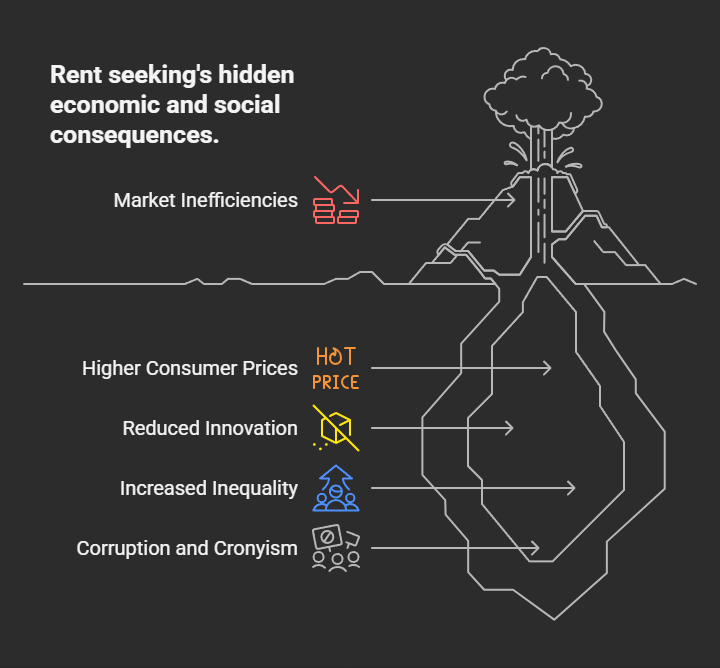
Why Rent Seeking Is Harmful to the Economy
Rent seeking—the practice of gaining wealth without contributing to productivity—creates serious economic and social consequences. Unlike profit earned through innovation or competition, rent-seeking profits are extracted through manipulation of political or legal systems.
Market Inefficiencies
When companies or individuals focus on lobbying, legal battles, or regulatory capture instead of creating value, resources are diverted from productive activities. This misallocation leads to slower economic growth and reduced output.
Example: A firm may invest millions in lobbying for exclusive rights rather than improving its products or services.
Higher Consumer Prices
Monopolies, tariffs, and exclusive licenses—often won through rent seeking—allow companies to limit competition and charge inflated prices for goods and services.
Result: Consumers pay more while receiving less value, reducing overall purchasing power.
Reduced Innovation
Barriers to entry, such as unnecessary regulations or exclusive deals, discourage new competitors and dampen the incentive to innovate.
Why innovate when profits can be secured through political influence instead of market improvement?
Increased Inequality
Rent seeking shifts wealth from the productive to the connected. Those with access to policymakers and influence secure unearned advantages, widening the gap between the powerful and the public.
Value creators struggle while lobbyists and insiders accumulate wealth.
Corruption and Cronyism
As influence becomes a more reliable path to success than merit, trust in institutions erodes. A system favoring political ties over innovation and efficiency breeds:
- Public disillusionment with democratic processes
- Corruption in public office
- Crony capitalism
Can Rent Seeking Be Prevented?
Rent seeking—when individuals or companies manipulate public policy or economic conditions to gain profits without contributing to productivity—is a widespread issue that drains resources and stifles innovation. But can it be prevented?
While completely eliminating rent seeking is difficult, smart reforms and vigilant public oversight can greatly reduce its impact. Here’s how:
Transparent Governance
Transparency is the cornerstone of accountability. When decisions are made behind closed doors, it opens the door for manipulation. Implementing these policies helps:
- Lobbying Disclosure Laws
Requiring detailed public records of lobbying activities helps expose special interest influence and prevents backroom deals. - Campaign Finance Reform
By limiting corporate donations and increasing transparency in political fundraising, we reduce elected officials’ dependency on corporate interests.
Competitive Markets
Monopolies thrive on rent seeking. Encouraging healthy market competition minimizes opportunities for manipulation.
- Reducing Barriers to Entry
Simplifying licensing processes and reducing unnecessary red tape allow small businesses and innovators to compete fairly. - Anti-Monopoly Enforcement
Strong antitrust laws prevent corporate giants from cornering markets and extracting unearned profits.
Public Awareness
An informed public is the best defense against economic manipulation.
- Media and Watchdog Groups
Investigative journalism and nonprofit watchdog organizations can bring rent-seeking behavior to light, holding actors accountable. - Economic Education
Teaching citizens about rent seeking and economic policy empowers voters to demand better legislation and governance.
Tax and Subsidy Reforms
Government policy can either enable or curb rent seeking.
- Closing Loopholes
Tax codes riddled with exemptions often reward rent seekers. Removing preferential treatments helps level the playing field. - Conditional Subsidies
Instead of blanket subsidies, tie government aid to measurable performance or innovation benchmarks.
Conclusion
Rent seeking is more than just an economic inefficiency—it’s a structural flaw that can weaken the very foundation of fair competition and democratic governance. When individuals, corporations, or interest groups manipulate rules, policies, or institutions to gain unearned financial advantage, they do so at the expense of broader societal well-being. Instead of fostering innovation, improving services, or contributing to economic output, rent seekers extract value without creating it, resulting in stagnation, inflated costs, and rising inequality.
Over time, unchecked rent seeking can erode public trust in institutions, fuel resentment, and concentrate power in the hands of a few. It distorts incentives across the system: companies may invest more in lobbying than in research and development; politicians may prioritize donors over constituents; and citizens may become disillusioned with a system they perceive as rigged.
However, rent seeking is not inevitable—and it is not unstoppable. Through a combination of smart policy, regulatory reform, and civic awareness, societies can reduce its prevalence and limit its damage. Here are a few pathways forward:
- Enhancing transparency in lobbying, campaign finance, and policymaking can expose hidden influences and help hold rent seekers accountable.
- Fostering open competition and reducing unnecessary barriers to entry can prevent monopolistic behavior and ensure that success is tied to value creation, not manipulation.
- Strengthening institutions that act as economic and legal watchdogs helps protect public interest from being subverted by private agendas.
- Educating the public and policymakers about rent seeking can empower citizens to question decisions that favor special interests and push for reforms that serve everyone.
Ultimately, a fair and thriving economy depends on rewarding productive behavior—not political favoritism or regulatory capture. Recognizing and addressing rent seeking is essential to promoting genuine innovation, equitable growth, and long-term prosperity. By aligning policies with the broader public good rather than narrow private gains, we can build systems that work better for all, not just the powerful few.