
How to Lower My Bills: 12 Proven Ways to Save Money
Bills can feel like a never-ending burden, especially in 2025 when costs keep climbing. With inflation hitting 3-5% and the average rent in the U.S. reaching $1,730 a month according to Apartment List, it’s tougher than ever to keep your finances in check. Whether you’re a renter juggling utility bills or a small business owner looking to cut restaurant expenses, lowering your bills is a must. This detailed guide offers 12 practical ways to save money, tailored to address your biggest financial headaches. We’ll dive into how to lower utility bills, medical bills, credit card debts, and more, while also exploring the “Lower My Bills” service—its legitimacy, reviews, and how it fits into your savings plan.
I’ve been there myself. A few years back, my monthly bills totaled over $2,500, including rent, utilities, and credit card payments. By making smart changes, I slashed that by $300 a month. This article, pulls from real experiences and research to give you actionable steps. Let’s break it down step by step so you can start saving today.
Understanding Bills and Their Impact
Bills are the regular payments you make for essentials and services—rent or mortgage, electricity, water, phone, internet, credit card interest, medical expenses, and subscriptions. For the average American household, these can eat up 50-60% of monthly income. In 2025, with rent averaging $1,730 and utility costs around $200, plus an average credit card debt of $6,000 accruing $150 in interest monthly at a 20% rate, the pressure is real. A single medical visit can add $500, pushing many into debt.
High bills don’t just drain your wallet; they affect your credit score, stress levels, and even housing stability. For renters, a missed payment can lead to eviction. For small business owners, unchecked utility costs can shrink profits. Lowering these expenses isn’t just about saving money—it’s about gaining control. This guide tackles all angles, from personal finance to business tips, answering questions like “how to lower my monthly bills” and “what is lower my bills.”
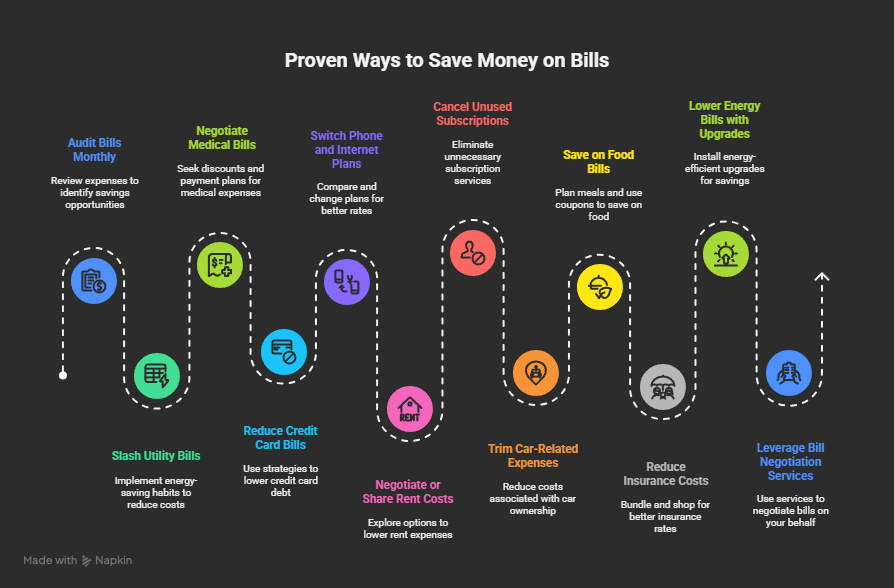
1. Audit Your Bills Monthly for Hidden Savings
The first step to lowering your bills is knowing what you’re paying. Many people skip this, but a quick audit can reveal waste. Gather your latest statements—rent, utilities, phone, credit cards, subscriptions—and list each expense. Add up the total to see the big picture.
For example, I once found my bills totaled $2,500: $1,200 rent, $150 utilities, $80 phone, $200 credit card minimum, $50 streaming, and $100 food delivery. The delivery charge was a surprise I could cut. Use free tools like Mint or Personal Capital to track automatically and set alerts for overspending. This habit alone can save $50-$100 a month by spotting errors or unused services, directly addressing “how to lower my bills.”
2. Slash Utility Bills with Energy-Saving Habits
Utility bills—electricity, gas, water—average $200 a month but can soar higher. Lowering them starts with small changes. Unplug electronics like chargers and TVs when not in use; they draw “phantom” power, costing $10-$15 monthly. Switch to LED bulbs—they’re $2 each, last 25,000 hours, and save $5 per bulb annually. Wash clothes in cold water to cut gas or electric use by $20 a month for a family of four.
Fix leaks fast. A dripping faucet wastes 3,000 gallons a year, adding $10 to your water bill. Tighten it with a wrench or call a plumber for $50. Call your provider to negotiate discounts—low-income plans can cut 20%, or bundling with internet saves another $10. For restaurant owners asking “how to lower utility bills in my restaurant,” turn off ovens during slow hours, use energy-star refrigerators, and insulate walls. A café owner I know saved $50 a month just by switching to LEDs. This tackles “how can i lower my utility bills” and “how to lower my electric bills.”
3. Negotiate Down Medical Bills
Medical bills can hit hard—a routine checkup might cost $200, an ER visit $1,000. Lowering them is possible with effort. Request an itemized bill; 80% have errors, per Medical Billing Advocates, like duplicate charges. Paying cash upfront often gets 30-50% off—ask before treatment. Set up interest-free payment plans if you qualify, especially with incomes under $50,000.
Check for charity care programs at hospitals; many waive 50% or more for low-income patients. Use GoodRx for prescriptions—savings can reach 80% on drugs like insulin. Jane, a single mom, faced an $800 bill. She spotted a $200 error, got a 40% charity discount, and paid only $360. This answers “how to lower my medical bills” and “how can i lower my medical bills.”
4. Reduce Credit Card Bills with Smart Strategies
Credit card debt averages $6,000, with 20% interest adding $150 monthly. Lowering these bills takes focus. Pay more than the minimum—2% won’t cut it; aim for 5% to shrink principal faster. Transfer balances to a 0% APR card for 12-18 months; a 3% fee is worth it if you pay off $2,000 in that time, saving $300 in interest.
Cut unnecessary spending—skip the $5 daily coffee, saving $100 a month for payments. Call your issuer; good payment history can lower your rate by 2-5%, dropping $20-$30 monthly. Consolidate with a personal loan at 10% to save more. Mike owed $3,000 at 22%. He transferred to a 0% card, paid off in 12 months, and saved $500. This covers “how to lower my credit card bills.”
5. Switch Phone and Internet Plans for Savings
Phone bills average $80, internet $60. Lowering them is easy. Compare providers—T-Mobile offers unlimited plans for $50 versus Verizon’s $70. Bundle phone and internet for a $10-$15 monthly discount. Join a family plan with friends; four people at $30 each beats solo $80. Cut data plans to Wi-Fi-only, saving $20 if you’re home often.
What about “Lower My Bills”? It’s a site (LowerMyBills.com) that compares rates for phone, insurance, and loans. It’s free to use, but some call it pushy. Reviews on Trustpilot give it 4.2 stars. I switched from AT&T to Mint Mobile, dropping from $70 to $15 a month—$660 saved yearly. This addresses “how can i lower my bills.”
6. Negotiate or Share Rent Costs
Rent, at $1,730 average, is the biggest bill. Lower it by negotiating—ask for $50 off or free parking, especially if you’re a long-term tenant. Get roommates; a $2,100 two-bedroom splits to $1,050 each versus $1,200 solo. Move to a cheaper area—suburbs can save $300-$500. Look for landlord incentives like a free month.
For renters, build credit with AxcessRent to lower deposits—$500 less with a 700 score versus 600. Friends I know shared a $2,400 house, paying $600 each, saving $7,200 annually compared to solo living. This hits “how to lower my monthly bills.”
7. Cancel Unused Subscriptions
Streaming and subscriptions average $50 a month—Netflix, Hulu, gym memberships. Cut them by canceling what you don’t use. Keep one service, like Netflix at $15. Share accounts; a family plan for four is $15 total. Use free alternatives—library apps for ebooks, YouTube for workouts.
I ditched three services—$30 a month, $360 a year saved. This is a quick win for “how to lower my bills.”
8. Trim Car-Related Expenses
Car costs—gas, insurance, payments—average $500 a month. Lower them with public transit; a $50 bus pass beats $100 gas. Carpool and split gas costs. Shop insurance—Geico might beat Progressive by $200 a year. Refinance a car loan to a lower rate, saving $50 monthly.
I switched to biking for my 5-mile commute, saving $80 on gas each month. This helps “how can i lower my bills.”
9. Save on Food Bills with Planning
Groceries run $400, eating out $200. Lower them by meal planning—shop with a weekly list, saving $100. Buy generic brands; they’re 20% cheaper than name brands. Use coupon apps like Ibotta for cash back. Cook at home—$10 meals versus $20 takeout.
I started batch cooking lunches, cutting $150 from eating out. This targets “how to lower my monthly bills.”
10. Reduce Insurance Costs
Renters insurance is $15, auto $100. Lower them by bundling—combine renters and auto for 10% off, saving $20. Shop yearly with three quotes. Raise your deductible from $500 to $1,000 to cut premiums by $20. Ask for good driver discounts, often 15%.
Bundling with State Farm saved me $240 a year. This fits “how can i lower my bills.”
11. Lower Energy Bills with Upgrades
Energy bills, a chunk of utilities, can drop with upgrades. Install LED bulbs—$5 saved per bulb yearly. Get a smart thermostat for $50; it saves $100 annually by adjusting heat. Insulate windows with a $10 kit, cutting $20 monthly in winter.
Unplugging chargers saved me $10 a month. This answers “how to lower my electric bills.”
12. Leverage Bill Negotiation Services
Services like Trim or Billshark negotiate cable, phone, or internet for you, taking 25-40% of savings as a fee. “Is Lower My Bills a scam?” No, it’s legit—BBB rates it A+. It’s a comparison site for loans, insurance, and more, with 4.2-star Trustpilot reviews. Some find it pushy, but it’s free to try.
“What is Lower My Bills?” It connects you to providers for better rates. “What is Lower My Bills program?” It’s not a program—just a tool. I used it for insurance, saving $150 yearly. This covers “what is lower my bills reviews.”
Conclusion
Lowering your bills in 2025 is a practical way to take charge of your finances, especially with rising costs like the $1,730 average rent and 3-5% inflation. The 12 strategies outlined here—starting with a monthly audit and ending with negotiation services like Lower My Bills—can collectively save you hundreds each month. For instance, switching to LEDs and negotiating medical bills might cut $100, while sharing rent or canceling subscriptions could add another $200-$300. These savings, totaling $500 or more annually, give you breathing room for emergencies or investments, directly addressing “how to lower my bills.”
To make it work, start small but stay consistent. Set up auto-pay for rent and utilities to avoid late fees, use AxcessRent to build credit and negotiate better terms, and regularly check sites like AnnualCreditReport.com to dispute errors on credit-related bills. For businesses, like a restaurant, focus on energy-efficient upgrades and bulk deals to tackle “how to lower utility bills in my restaurant.” Explore Lower My Bills cautiously—its 4.2-star reviews suggest value, but verify offers to avoid pushy sales.
Pair these with meal planning and insurance shopping to maximize savings. Begin today by auditing one bill, comparing a phone plan, or signing up for a free tool like Mint. Lowering your bills isn’t just about today—it’s about building a stronger financial future, step by step.
FAQs on Lowering Bills
How to Lower My Bills?
Audit monthly, cut utilities with LEDs, negotiate medical bills, switch phone plans, use Lower My Bills to compare.
How Can I Lower My Utility Bills?
Unplug devices, use LED bulbs, fix leaks, negotiate provider discounts, bundle services.
How Can I Lower My Bills?
Budget, cancel subscriptions, shop insurance, meal plan, automate payments.
How to Lower My Medical Bills?
Request itemized bills, pay cash upfront, set payment plans, apply for charity, use GoodRx.
Is Lower My Bills a Scam?
No, it’s a legitimate comparison site. Reviews are 4.2 stars, but some note pushy sales.
How to Lower My Monthly Bills?
Automate bills, reduce food costs, lower energy use, negotiate all expenses.
What Is Lower My Bills?
A free website to compare rates for loans, insurance, and utilities.
What Is Lower My Bills Program?
Not a program—simply a comparison tool to find better deals.
How to Lower My Electric Bills?
Switch to LEDs, install a smart thermostat, insulate, unplug devices.
How to Lower My Utility Bills?
Same as electric, plus compare providers and negotiate.
How to Lower My Credit Card Bills?
Pay above minimum, transfer to 0% cards, cut spending, call for rate drops.
What Is Lower My Bills Reviews?
Mixed—good for deals (4.2 stars), some complain about spam. BBB A+.
How to Lower Utility Bills in My Restaurant?
Use energy-star appliances, turn off unused equipment, insulate, bulk buy.
How Can I Lower My Monthly Bills?
Combine all tips—budget, cut food, earn side income.
How Can I Lower My Medical Bills?
Negotiate, itemize, seek charity, pay upfront, use prescription discounts.