First-Time Auto Loan Requirements: What Lenders Look For
Securing your first auto loan is a significant financial milestone, but for many, it feels like a “Catch-22”: you need credit to get a loan, but you need a loan to build credit. However, lenders—especially credit unions—have specific frameworks designed to help first-time buyers enter the market safely.
This guide will walk you through the process of obtaining an approval, identifying the best lenders, and navigating the unique requirements of first-time buyer programs.
1. What Is the Best Auto Loan for First-Time Buyers?
While major national banks offer convenience, the “best” auto loan for a first-time buyer is almost universally found at a Credit Union.
Why Credit Unions Win for First-Timers:
- Relationship-Based Lending: Unlike big banks that rely strictly on algorithmic “Pass/Fail” scores, credit unions often look at the “whole person,” including your employment stability and local ties.
- First-Time Buyer Programs: Many credit unions offer specific “First-Time Auto Buyer” packages. these often include:
- Capped interest rates (preventing the 20%+ predatory rates often found at “Buy Here Pay Here” lots).
- Lower down payment requirements.
- Educational requirements (a short video or quiz on car buying) in exchange for a rate discount.
- Lower Fees: As member-owned cooperatives, credit unions generally have lower overhead, which translates into fewer “origination” or “documentation” fees.
2. Understanding “First-Time Buyer” Eligibility
Lenders define a “First-Time Buyer” not just as someone who hasn’t owned a car, but as someone who has no previous auto finance trade-line on their credit report.
Common Requirements:
- Credit Score: While you don’t need a 700+ score, most programs look for at least a 600–620. If you have no score at all (a “thin file”), lenders will look for “alternative credit,” such as a history of on-time rent or utility payments.
- Employment History: Lenders typically want to see at least 6 to 12 months at your current job or a guaranteed offer letter if you are a recent college graduate.
- Debt-to-Income (DTI) Ratio: Lenders generally want your total monthly debt payments (including the new car) to be less than 35–45% of your gross monthly income.
- Income Minimums: Most first-time programs require a minimum gross monthly income of $2,000 to $2,500.
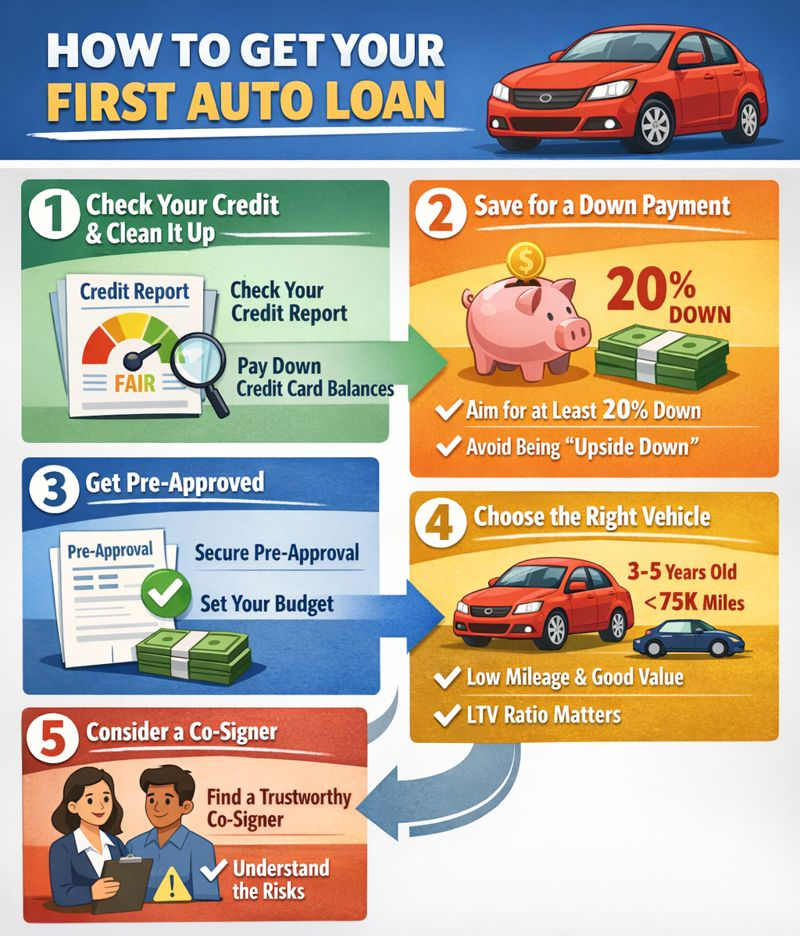
3. Step-by-Step: How to Get Your First Auto Loan
Step 1: Check Your Credit and Clean It Up
Six months before you plan to buy, pull your credit report. If you have high credit card utilization (as discussed in our previous guide), pay those balances down. This is the fastest way to boost your score before a lender sees it.
Step 2: Save for a Substantial Down Payment
For a first-time buyer, “Skin in the Game” is crucial. While some programs allow for low down payments, putting down 20% significantly lowers the lender’s risk. It proves you have the discipline to save and ensures you don’t end up “upside down” (owing more than the car is worth) the moment you drive off the lot.
Step 3: Get Pre-Approved (The Golden Rule)
Never walk into a dealership without a pre-approval from a credit union or bank. A pre-approval turns you into a “cash buyer” in the eyes of the dealer. It sets a hard ceiling on your budget and prevents the dealer from inflating your interest rate to increase their commission (a practice known as “yield spread premium”).
Step 4: Choose the Right Vehicle
Lenders are more likely to approve a first-time loan on a vehicle that holds its value.
- Age: Ideally 3–5 years old.
- Mileage: Under 75,000 miles.
- The “LTV” Ratio: Lenders look at Loan-to-Value. If the car is priced at $15,000 but the “Book Value” (NADA or KBB) is only $12,000, they will likely deny the loan or require a larger down payment.
Step 5: Consider a Co-Signer (If Necessary)
If your credit score is too low or your income is inconsistent, a co-signer with strong credit can help you qualify for a much lower rate. Warning: The co-signer is 100% legally responsible for the debt if you stop paying. This is a significant favor and should be treated with the utmost responsibility.
4. First-Time Buyer Program Nuances
Many manufacturers offer “College Graduate Programs” (e.g., Toyota Financial, Honda Financial) that are tailored for those with limited credit but high earning potential.
| Feature | Typical Standard Loan | First-Time Buyer Program |
|---|---|---|
| Primary Factor | FICO Score | Income/Employment Stability |
| Down Payment | 0% – 10% | 10% – 20% |
| Interest Rate | Market Based | Slightly higher than “Prime” |
| Max Loan Term | 72–84 Months | Usually capped at 60 Months |
5. Common Pitfalls to Avoid
- Focusing Only on Monthly Payment: Dealers will try to sell you a car based on a “monthly payment” you can afford. They do this by stretching the loan term to 72 or 84 months. You end up paying thousands more in interest. Always negotiate based on the Total Purchase Price.
- Skipping the Pre-Purchase Inspection (PPI): For your first car, spend the $150 to have an independent mechanic look at the vehicle. A loan for a car that doesn’t run is the fastest way to ruin your credit.
- Ignoring Insurance Costs: For a first-time driver, insurance on a financed vehicle (which requires “Full Coverage”) can sometimes cost as much as the loan payment itself. Get an insurance quote before signing the loan.
6. Summary Checklist
- Join a Credit Union: Open an account at least 3 months before applying.
- Check Credit Utilization: Keep it under 10% leading up to the application.
- Gather Docs: Have 2 recent paystubs, 2 months of bank statements, and proof of residence (utility bill) ready.
- Calculate Your Budget: Use the 20/4/10 rule (20% down, 4-year term, total car costs under 10% of gross income).
- Apply for Pre-Approval: Compare at least one credit union and one online lender.
Conclusion
Getting a first-time auto loan is less about having a perfect past and more about proving a stable future. By targeting credit unions, bringing a solid down payment, and focusing on the total cost of the vehicle rather than just the monthly payment, you can secure a loan that builds your credit rather than burdens it.
Frequently Asked Questions (FAQs)
Can I get an auto loan with zero credit history?
Yes, but it is more difficult. Many credit unions and “College Grad Programs” through manufacturers (like Ford or Honda) specifically cater to those with “no credit.” They will substitute a FICO score with proof of a steady job and a history of on-time utility or rent payments. Expect to provide a larger down payment in these cases.
What is a “good” interest rate for a first-time buyer?
“Good” is relative. While someone with perfect credit might get 5-6%, a first-time buyer with limited credit can expect 8% to 12%. Anything above 15% is considered high, and you should attempt to refinance the loan after 12 months of on-time payments to bring that rate down.
Do I really need a co-signer?
Not always, but it helps tremendously. A co-signer with a strong credit history can lower your interest rate by half in some cases. However, if you have a stable job and a 20% down payment, many first-time buyer programs will approve you on your own merit.
How much should I spend on my first car?
Financial experts recommend the 10% Rule: Your total monthly car expenses (loan payment, insurance, and gas) should not exceed 10% of your gross monthly income. If you earn $3,000 a month, your total “car budget” is $300.
Does a pre-approval hurt my credit score?
A pre-approval involves a “hard pull,” which may drop your score by 5–10 points. However, credit scoring models recognize “rate shopping.” If you apply with three different lenders within a 14-day window, it usually only counts as a single hard pull.