How much debt to file chapter 7 bankruptcy ?
If you are looking for a specific “magic number” in the law books that says “You must owe $15,342 to file for bankruptcy,” you aren’t going to find it. The law doesn’t actually set a minimum amount of debt.
Technically, you could file Chapter 7 over a $500 phone bill, but that would be a huge mistake. Here is the breakdown of how to decide if your debt is “high enough” to hit the reset button.
1. The “Cost vs. Reward” Rule
Filing for bankruptcy isn’t free. You have to pay court fees and, usually, a lawyer to make sure you don’t lose your house or car.
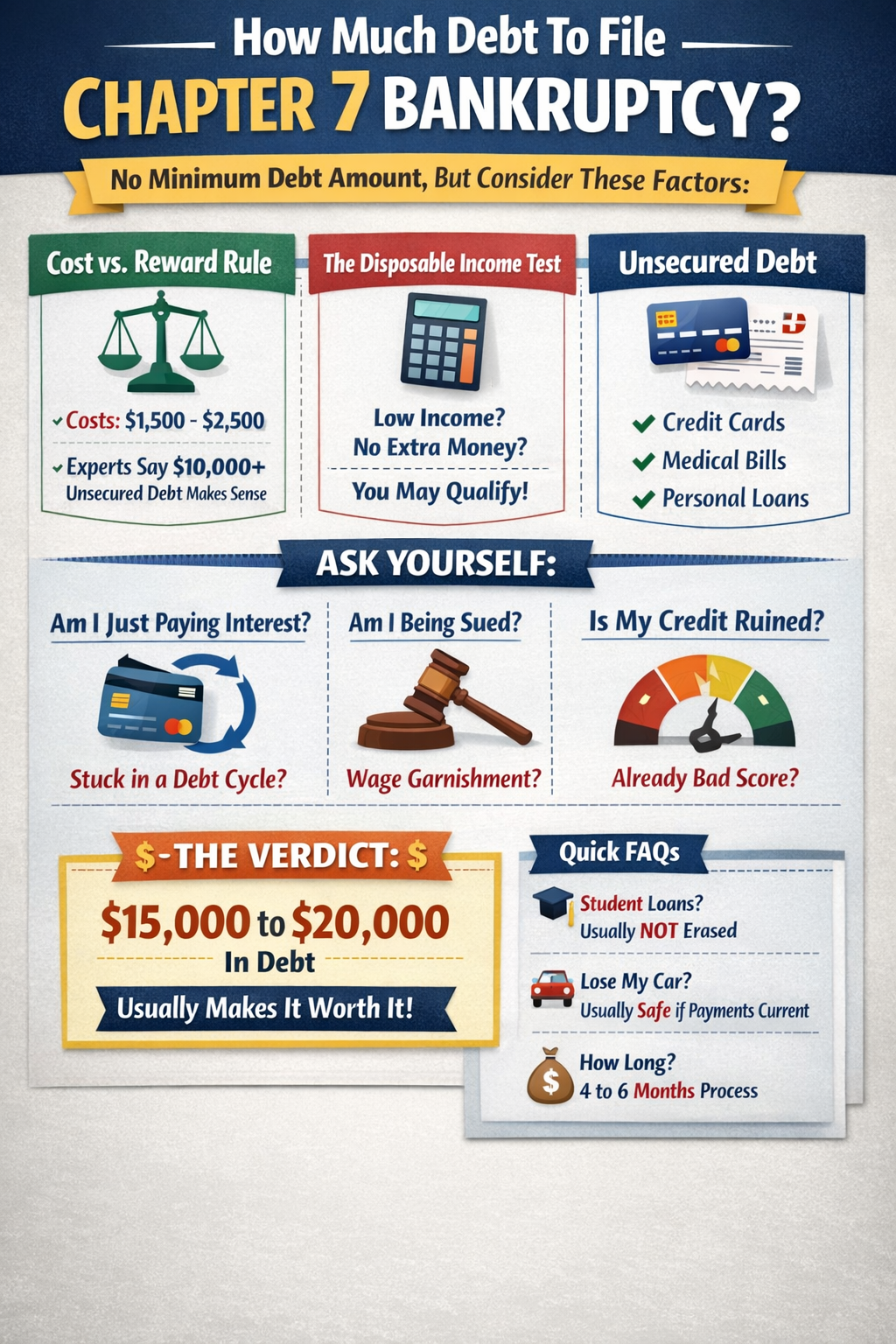
- The Cost: Expect to pay between $1,500 and $2,500 in total fees.
- The Logic: If you only owe $3,000, paying $2,000 to get rid of it doesn’t make sense. You’d be better off just paying the debt. Most experts suggest that unless you have at least $10,000 in “unsecured” debt (like credit cards or medical bills), the math just doesn’t add up.
2. The “Disposable Income” Test
Instead of looking at how much you owe, the court looks at how much you make. This is called the Means Test.
- If you make $5,000 a month and your bills are only $2,000, the court will say you have $3,000 left over. They will tell you to use that extra money to pay your debts instead of erasing them.
- Chapter 7 is for people whose “disposable income” is basically zero. If you literally cannot afford to pay the debt back over the next five years, you are a candidate.
3. The “Unsecured” Factor
Bankruptcy works best for “unsecured” debt.
- The Good Stuff to Erase: Credit cards, personal loans, and hospital bills.
- The “Un-erasable” Stuff: Student loans, child support, and recent taxes usually stay with you even after bankruptcy.
- The “Secured” Stuff: If you owe $20,000 on a car and want to keep the car, you still have to pay that debt.
Is it worth it for you?
Instead of asking “Is my debt big enough?”, ask these three questions:
- Am I just paying interest? If your monthly payments only cover the interest and the total balance never goes down, you’re stuck in a loop.
- Am I being sued? If debt collectors are taking money directly from your paycheck (garnishment), bankruptcy stops them instantly.
- Is my credit already ruined? If your score is already in the basement, the “damage” of bankruptcy doesn’t matter as much because the slate gets wiped clean.
The Verdict: While there is no legal minimum, most people find that $15,000 to $20,000 is the point where the benefits of a fresh start finally outweigh the costs and the hit to your credit score.
Common Questions (FAQs)
1. Can I file if I owe less than $10,000?
Yes. There is no legal floor. However, since filing costs money and affects your credit, it’s usually not recommended unless the debt is truly unpayable.
2. Does Chapter 7 clear my student loans?
Almost never. Unless you can prove “undue hardship” (which is very hard to do in court), those loans will still be there after your case is over.
3. Will I lose my house or car?
Most people don’t. Every state has “exemptions” that protect a certain amount of equity in your home and vehicle. If your car is paid off and worth $20,000, you might have an issue, but a daily driver is usually safe.
4. How long does the process take?
Chapter 7 is fast. From the day you file to the day your debt is legally erased (discharged), it usually takes about 4 to 6 months.
5. How bad will this hurt my credit score?
If your score is already low because of missed payments, it might not drop much further. It stays on your credit report for 10 years, but you can start rebuilding your score almost immediately after the discharge.
6. Do I have to go to court?
You usually attend a “Meeting of Creditors” (also called a 341 meeting). It’s not a formal trial with a judge; it’s a short meeting with a trustee to verify your paperwork.
7. Can I choose which debts to include?
No. You are legally required to list every person and company you owe money to. You can’t leave your favorite credit card out of the filing.
8. Can I file bankruptcy more than once?
Yes, but you have to wait. You can only get a Chapter 7 discharge once every 8 years.
9. Will my boss find out?
Bankruptcy is a public record, but the court doesn’t send a letter to your employer. Unless they run a credit check on you, they likely won’t know.
10. What is the “Means Test”?
It’s a calculation that compares your income to the median income in your state. If you earn less than the median, you automatically qualify for Chapter 7. If you earn more, you might be forced into Chapter 13.