Which statement best describes how an investor makes money off debt?
If you are looking for the shortest, most accurate answer, it is this: An investor makes money off debt by acting as a lender, collecting regular interest payments (the “coupon”), and receiving the return of their original principal at a later date.
While equity investors (stock buyers) make money through company growth and dividends, debt investors make money through predictability and contractual obligations. However, the sophisticated world of credit involves much more than just collecting checks. To truly understand the profit motives of a debt investor, one must look at the interplay between interest rates, market risk, and the hierarchy of capital.
The Core Mechanics: How the Money is Made
To understand how this works in the real world, we need to look at the primary avenues of profit in the debt market.
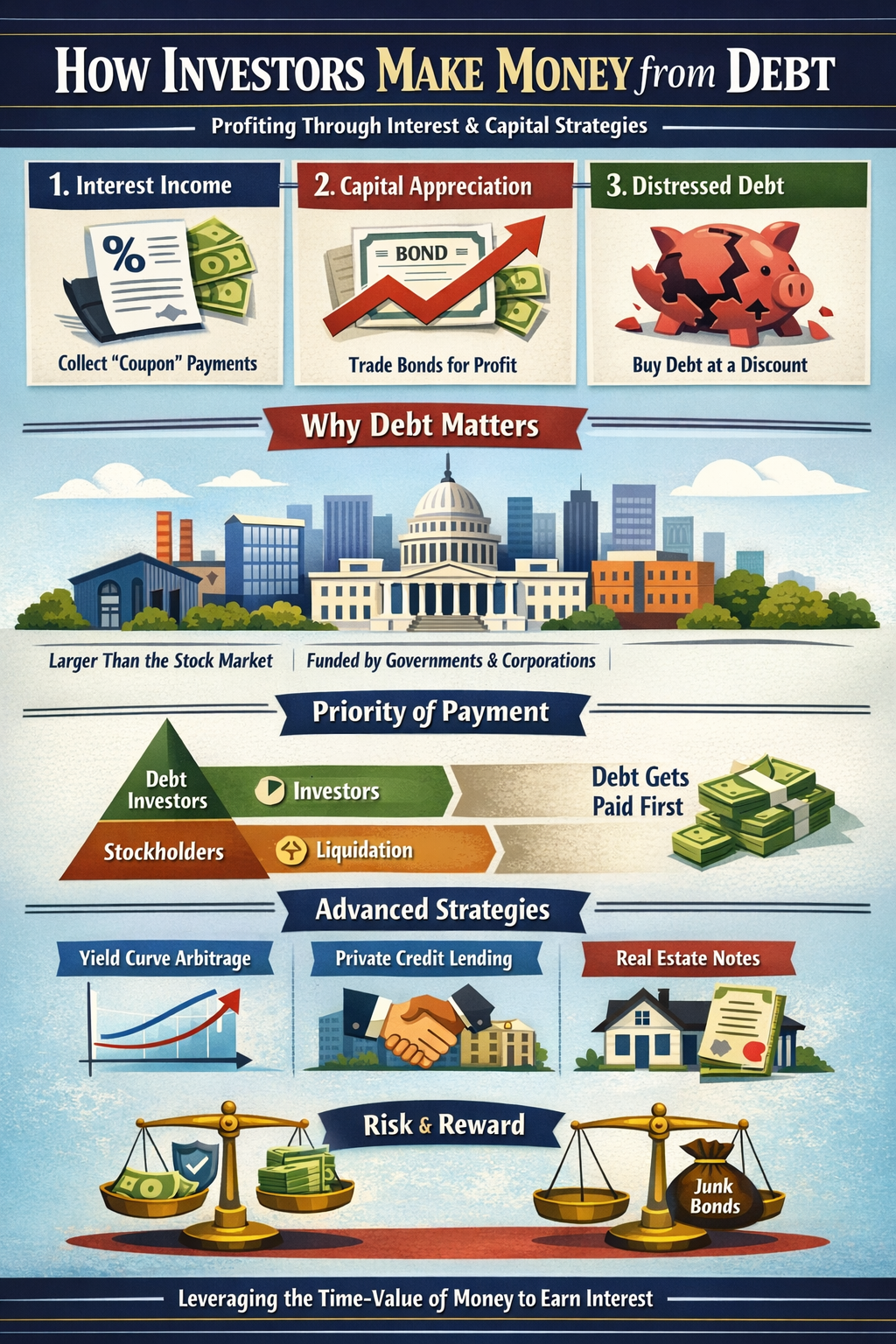
1. Interest Income (The Coupon Rate)
When you buy a bond or lend money through a Peer-to-Peer (P2P) platform, you are essentially “playing the bank.” The borrower agrees to pay you a “rent” for using your money over a specific period.
- Fixed Income: Most debt instruments pay a fixed percentage annually. This provides a steady stream of cash flow that is highly attractive to retirees or institutional investors.
- Compound Gains: For long-term investors, reinvesting these interest payments is the primary driver of wealth. You can learn more about optimizing fixed income portfolios to maximize these returns over decades.
2. Capital Appreciation (Secondary Market Trading)
Debt isn’t just a “buy and hold” game. Bonds are traded on the open market like stocks. If you hold a bond paying 5% interest and the market interest rates drop to 2%, your 5% bond becomes much more valuable.
- The Inverse Relationship: When market rates fall, bond prices rise. Investors can sell their debt holdings at a premium before the maturity date, capturing a profit that exceeds the initial interest agreement. For a deeper dive, check out our guide on bond market volatility.
3. Deep-Discount Purchasing (Distressed Debt)
Professional investors often buy “bad debt” for pennies on the dollar. If an investor buys $10,000 of consumer debt from a bank for $500, and manages to collect just $2,000 of it, they have quadrupled their investment. This is a high-risk, high-reward strategy often utilized by alternative investment funds.
Why Debt is the “Foundation” of Global Finance
The debt market, often called the “Credit Market,” is actually significantly larger than the global stock market. Governments use it to build infrastructure, and corporations use it to fund expansion without giving up ownership. For the investor, this creates a vast landscape of opportunities.
The Hierarchy of Payment
In the event of a corporate liquidation, debt holders are legally protected by the “Absolute Priority Rule.” This means they are paid back before any stockholders see a dime. This safety net allows investors to accept lower returns in exchange for capital preservation. Understanding corporate credit ratings is vital for gauging this level of safety.
External Resources & Authority Links
For those looking to deepen their understanding of financial markets and credit structures, exploring authoritative industry analysis is essential. You can find comprehensive data on market trends and investment strategies at Investopedia to better understand the nuances of various debt instruments. Additionally, the SEC’s guide to bonds provides a regulatory perspective on investor protection.
Advanced Profit Strategies in Debt
Beyond simple bonds, seasoned investors use more complex tools to generate alpha.
1. Arbitrage and the Yield Curve
Investors look at the “Yield Curve”—the difference between short-term and long-term interest rates. By predicting how this curve will shift, they can position themselves in short-term debt instruments or long-term notes to capture maximum spread.
2. Private Credit and Direct Lending
With banks becoming more regulated, private investors have stepped in to provide “Private Credit.” These are bespoke loans to mid-sized companies that offer higher interest rates than the public markets. You can explore the pros and cons of private lending in our detailed analysis.
3. Real Estate Notes
Investing in mortgage debt allows you to collect interest backed by physical collateral. If the borrower defaults, you may have the right to seize the property. This provides a tangible layer of security not found in corporate debt. Learn about investing in mortgage notes for passive income.
FAQ: Investor Perspectives
How does debt investing differ from stock investing?
In stock investing, you own a piece of the company and your profit is uncapped. In debt investing, you are a creditor. Your profit is capped at the agreed-upon interest rate, but you have a higher legal priority. We break down the debt vs. equity comparison in our strategy center.
What is the “Spread” in debt investing?
The spread is the difference between the cost of borrowing money and the interest rate charged to the borrower. Banks make money by paying you a low rate on your savings and charging a higher rate on loans. The difference—the net interest margin—is their profit.
Is debt investing risky?
The primary risk is Default Risk—the possibility that the borrower simply stops paying. To compensate for this, “junk bonds” offer much higher interest rates. Investors must balance the risk-reward ratio carefully.
What is the impact of inflation on debt?
Inflation is the enemy of the debt investor. If you are earning 4% interest but inflation is 5%, you are technically losing purchasing power. This is why many investors look toward inflation-protected securities.
Summary
The most accurate statement describing how an investor profits from debt is that they leverage the time-value of money by charging interest in exchange for capital liquidity. Unlike equity owners who seek speculative growth, debt investors prioritize contractual yield. They profit through consistent interest payments (coupons), capital gains from secondary market price fluctuations driven by interest rate shifts, and the strategic acquisition of discounted distressed assets.
FAQs on Debt Investing
1. What is a “Coupon” in debt investing?
It is the annual interest rate paid by the issuer of a bond, usually paid semi-annually, expressed as a percentage of the face value.
2. Why do interest rates and bond prices move in opposite directions?
When new bonds offer higher rates, existing bonds with lower rates lose value. To make them sellable, their price must drop until their effective yield matches the new market rate.
3. What is a Treasury Bond?
A debt security issued by the federal government. It is considered “risk-free” because it is backed by the government’s ability to tax and print currency.
4. Can individuals invest in debt, or is it just for banks?
Individuals can easily participate through Bond ETFs, mutual funds, or by purchasing individual bonds through a standard brokerage account.
5. What is “Private Credit”?
This involves non-bank lenders (like private equity firms) providing loans directly to companies. It often offers higher yields due to the “illiquidity premium.”
6. What happens if a company defaults on my debt investment?
You enter a restructuring process. Debt holders are the first in line for assets. Often, debt is converted into equity, making the lenders the new owners of the company.
7. Is the interest from debt taxed differently?
Yes, interest income is usually taxed as ordinary income, which can be higher than the capital gains rates applied to stock appreciation.
8. What is “Yield to Maturity” (YTM)?
YTM is the total return anticipated on a bond if it is held until the end of its lifetime. It considers the purchase price, coupon payments, and the time remaining.
9. How do “Real Estate Notes” work?
Investors buy the “paper” (the loan) from a bank. The investor becomes the “lender” to whom the homeowner sends their monthly mortgage checks.
10. What is the biggest advantage of debt over equity?
Reliability. While a stock’s value can go to zero and stay there, debt is a legal contract. As long as the entity exists, they are legally obligated to prioritize your payment.