Federal vs Private Student Loans: A Complete Financing Guide
Let’s be real for a second. If you’re reading this, you’re probably sitting at your kitchen table with a stack of papers from the financial aid office, feeling like you need a math degree just to understand how to pay for your degree. Maybe you’re a parent trying to help your kid avoid the “debt trap,” or maybe you’re the student wondering why everything costs as much as a small house these days.
The problem is that the system is confusing on purpose. One minute you’re picking out dorm bedding at the local Target, and the next, you’re staring at words like “capitalization” and “subsidized” like they’re a foreign language. If you don’t get this right, you could end up paying back double what you borrowed. But don’t worry—we’re going to break down the difference between federal and private loans so you can make a plan that actually works. By the end of this, you’ll know exactly which papers to sign first and how to keep your future self from being totally broke.
Why Federal Loans Are the MVP
Think of federal loans like that one reliable friend who always has your back. They aren’t perfect, but they’re way more chill than a big bank. The government isn’t trying to make a huge profit off you; they just want you to get your degree and join the workforce.
The Magic of Subsidized Loans
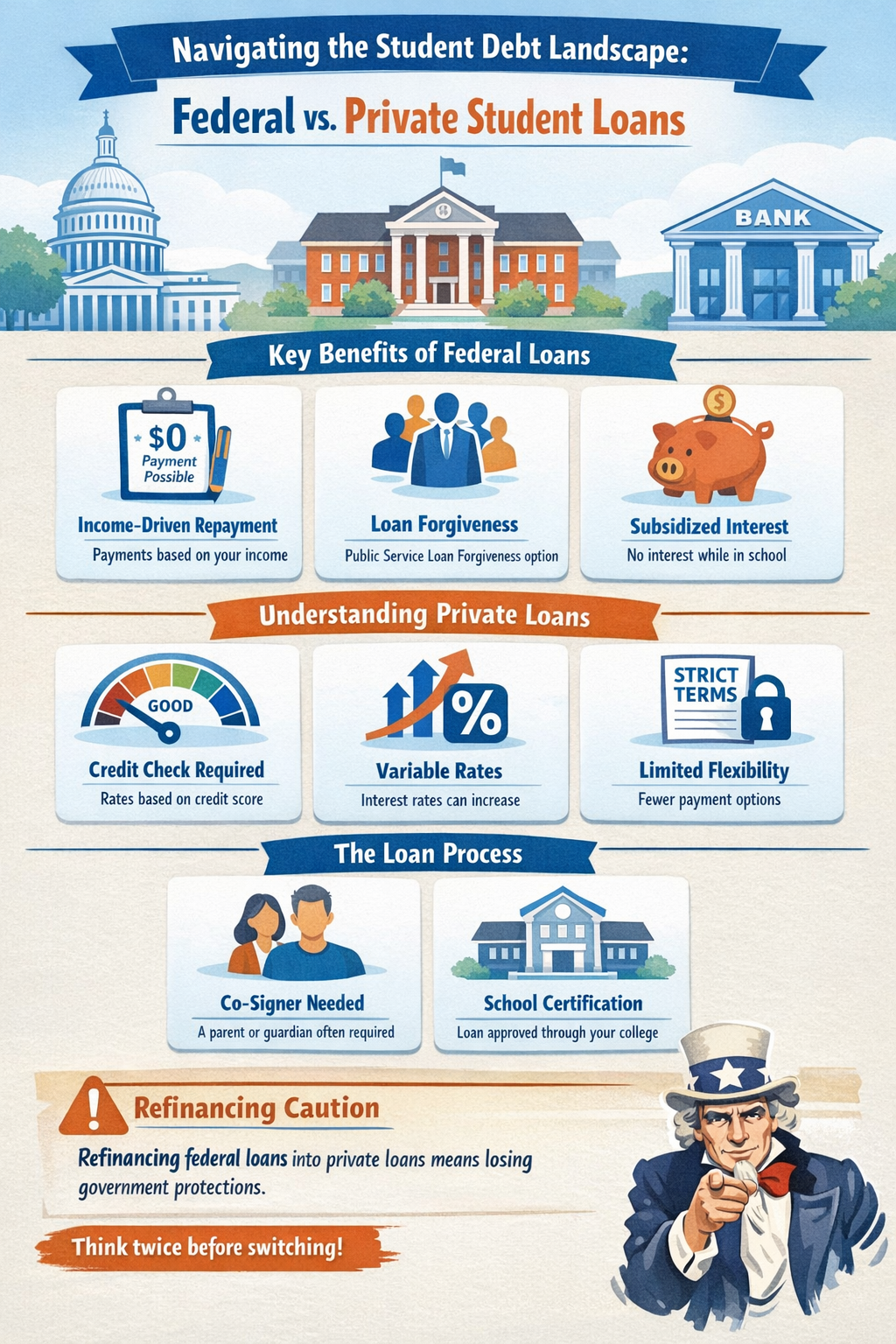
Imagine you go to a local diner with a friend. You order a burger, but your friend tells you, “Hey, I’ll pay the interest on that burger for the next four years while you’re in school.” That’s a subsidized loan. The government pays the interest while you’re studying. If you borrow $5,000, when you graduate, you still only owe $5,000. It’s basically a massive discount.
The “I Can’t Find a Job” Safety Net
Life happens. Maybe the job market in our area gets a little tight after you graduate, or you decide to take a lower-paying job at a local non-profit. Federal loans have “Income-Driven Repayment” plans. This means if you aren’t making much money, your monthly payment could be $0. And the best part? You won’t get in trouble for it. They just wait until you’re back on your feet.
No Credit? No Problem.
Most 18-year-olds don’t have a credit score. They’ve never had a car loan or a mortgage. Federal loans don’t care. They’ll give you the money anyway. Private banks, on the other hand, will look at a teenager with no credit history like they’re a high-stakes gambler.
Enter the Private Loan: The “Gap Filler”
Now, what happens if the government doesn’t give you enough? This is where private loans come in. These are from banks like Sallie Mae or even local credit unions.
Think of a private loan like a credit card for your education. It’s there if you need it, but you’ve got to be careful. These guys are businesses. They want their money back, and they want it with interest.
Meet “The Co-Signer” (Usually Mom or Dad)
Since most students don’t have a big income or a high credit score, a bank isn’t going to just hand over $20,000. They’ll ask for a co-signer.
Imagine this fictional scenario: Let’s call our student “Alex.” Alex wants to go to a state school but is $10,000 short. Alex’s Aunt Sarah steps in as a co-signer. This means if Alex decides to disappear to a beach in Hawaii and stop paying the loan, the bank is going to go straight to Aunt Sarah’s house and demand the money. It’s a huge deal for the person signing with you.
The Interest Starts Now
Unlike those nice subsidized federal loans, private loans usually start growing the second the bank sends the money to the school. While you’re sitting in your 101 biology class, your loan is getting bigger every single day.
How to Actually Apply (Without Pulling Your Hair Out)
If you’ve checked the local scholarships and the federal aid and you still need a bit more, here’s how you handle the private loan side of things:
- Check the Credit Score: If you’re the co-signer, make sure your credit is in good shape. A higher score means a lower interest rate, which can save you thousands.
- Compare, Compare, Compare: Don’t just go with the first bank that pops up on Google. Check out local credit unions too. Sometimes the folks right down the street give better deals than the giant national banks.
- Look for the “Get Out” Clause: Some lenders have a “co-signer release.” This means after the student makes a few years of on-time payments, the co-signer gets taken off the hook. This is a huge win for everyone’s relationship at Thanksgiving.
When Refinancing Makes Sense ?
Let’s say you’ve graduated. You’ve got a job at one of the big offices downtown, and you’re finally making some decent money. You might be stuck with a private loan that has a 12% interest rate because you didn’t have a great credit score back then.
Refinancing is like a do-over. You go to a new bank and say, “Hey, I’m a professional now with a real paycheck. Can I have a better rate?” If they say yes, they pay off your old expensive loan and give you a new, cheaper one. It’s one of the smartest things you can do once you’ve been working for a year or two.
Conclusion
Our team here sees people dealing with this every day. We’re just like you—we’ve got kids heading to college and we’ve sat through those long financial aid meetings. We aren’t here to push you into a loan you don’t need. We just want you to have the facts.
The “Golden Rule” is simple: Federal first. Max out those government loans before you even look at a private bank. Use private loans only as a last resort to bridge the gap.
College should be about your future, not about worrying how you’ll pay for your past. Take it slow, ask questions, and don’t sign anything until you’re sure it’s the best deal for your family. You’ve got this!
Final Summary Table
| Feature | Federal Student Loans | Private Student Loans |
|---|---|---|
| Source | U.S. Department of Education | Banks, Credit Unions, Online Lenders |
| Interest Rate | Fixed (set by federal law) | Fixed or Variable (set by lender) |
| Credit Check | Not required for most (except PLUS) | Required; determines rate |
| Co-signer | Usually not required | Almost always required for students |
| Repayment Options | Highly flexible (IDR, Deferment) | Limited; varies by lender |
| Forgiveness | PSLF, Teacher Forgiveness, etc. | Almost never available |
| Subsidies | Available for those with need | No subsidies available |
| Refinancing | Can be consolidated within federal | Recommended to lower commercial rates |
FAQ
Q1: Can I have both federal and private student loans at the same time?
Yes. Most students utilize federal loans first because they are capped at certain annual limits. If those limits do not cover the full cost of the degree, a private loan is used to “bridge the gap.” You will simply have two different portals to manage your payments.
Q2: What happens to my loans if I die or become permanently disabled?
Federal loans are legally required to be discharged (canceled) in the event of the borrower’s death or total and permanent disability. Private lenders vary; while many have adopted similar policies in recent years to improve their reputation, some may still attempt to collect from the borrower’s estate or the co-signer. Always read the fine print on “death and disability waivers” in private contracts.
Q3: Is there a limit to how much I can borrow in federal loans?
Yes. For dependent undergraduate students, the total (aggregate) limit for federal Direct Loans is currently $31,000. For independent students or those whose parents are unable to get a PLUS loan, the limit is higher ($57,500). If your education costs more than these amounts over four years, you will likely need to look at private options or Parent PLUS loans.
Q4: Does the interest on student loans count as a tax deduction?
Generally, yes. You can often deduct up to $2,500 of the interest paid on qualified student loans (both federal and private) from your taxable income. This is an “above-the-line” deduction, meaning you don’t need to itemize to claim it, though income limits do apply.
Q5: Can student loans be discharged in bankruptcy?
It is notoriously difficult but not impossible. Under current U.S. law, borrowers must prove “undue hardship,” which is a very high legal bar. However, recent guidance from the Department of Justice and the Department of Education has made the process slightly more accessible for federal borrowers who meet specific criteria. Private loans remain very difficult to discharge in bankruptcy.
Q6: What is a “Grace Period”?
A grace period is the amount of time you have after graduating, leaving school, or dropping below half-time enrollment before you must begin making payments. For federal loans, this is typically six months. Private lenders may offer a similar six-month window, but some require interest-only payments even while you are in school.
Q7: What is the difference between a subsidized and an unsubsidized loan?
On a subsidized loan, the government pays the interest while you’re in school. On an unsubsidized loan, interest starts “capitalizing” (adding to your principal balance) as soon as the loan is sent to your school. You aren’t required to pay it while in school, but the loan will be much larger by the time you graduate if you don’t.
Q8: Should I choose a fixed or variable interest rate for a private loan?
A fixed rate stays the same for the life of the loan, providing predictable monthly payments. A variable rate fluctuates based on the market. If you plan to pay the loan off very aggressively (within 2–3 years), a variable rate might save you money if it starts lower. If you plan to take 10 years to pay it off, a fixed rate is much safer.
Q9: Can I pay off my student loans early without a penalty?
Federal law prohibits “pre-payment penalties” on both federal and private student loans. You are always allowed to pay more than the minimum or pay the entire balance off early to save on interest.
Q10: What is the “Master Promissory Note” (MPN)?
The MPN is the legal document you sign when taking out a federal loan. It is a binding contract in which you promise to repay the loan plus interest. It also outlines all the terms and conditions of the borrowing agreement.