
Common Rent Reporting Mistakes and How to Fix Late Payment
Rent reporting is a powerful way to build credit by turning your monthly rent payments into a positive mark on your credit report. In 2025, with tools like AxcessRent and Experian Boost gaining popularity, more renters are using this strategy to boost their credit scores. But mistakes in rent reporting can hurt your credit instead of helping it, and fears about late payments can make you hesitant to start. This guide covers the most common rent reporting mistakes, how to fix them, and how to overcome worries about late payments. It’s packed with practical tips, real-world examples, and answers to trending queries like “What are common rent reporting mistakes?” and “How to fix late rent payments on credit reports?”
Whether you’re a first-time renter or looking to improve your credit, this guide will help you navigate rent reporting confidently and avoid pitfalls that could cost you points on your credit score.
What Is Rent Reporting?
Rent reporting is when your monthly rent payments are sent to major credit bureaus (Equifax, Experian, TransUnion) to be included in your credit report. Services like AxcessRent, Experian Boost, or RentTrack make this possible by verifying your payments with your landlord or bank records. On-time rent payments add positive payment history, which is 35% of your FICO score, potentially raising your score by 20–100 points in 6–12 months, according to Experian data.
For example, paying $1,200/month in rent consistently for a year can transform a thin credit file into a robust one, helping you qualify for loans, credit cards, or better rental applications. But mistakes in the process—like missing payments or choosing the wrong service—can backfire, lowering your score or wasting money.
Why Rent Reporting Matters in 2025
In 2025, rent reporting is more relevant than ever. The Credit Access and Inclusion Act, passed in April 2025, encourages credit bureaus to include alternative data like rent payments, helping the 40 million “credit invisible” Americans (per Senator Tim Scott) build credit. With economic pressures like rising costs (average emergency expense: $1,400, per PYMNTS), a strong credit score is crucial for financial opportunities. Rent reporting lets you turn a regular expense—rent—into a credit-building tool without taking on debt.
However, fears about late payments stop many renters from starting. A single late payment can drop your score by 50+ points, and mistakes in reporting can make things worse. This guide addresses those fears and shows you how to avoid common errors.
Common Rent Reporting Mistakes and How to Fix Them
Here are the top 10 rent reporting mistakes renters make, along with practical fixes to keep your credit on track.
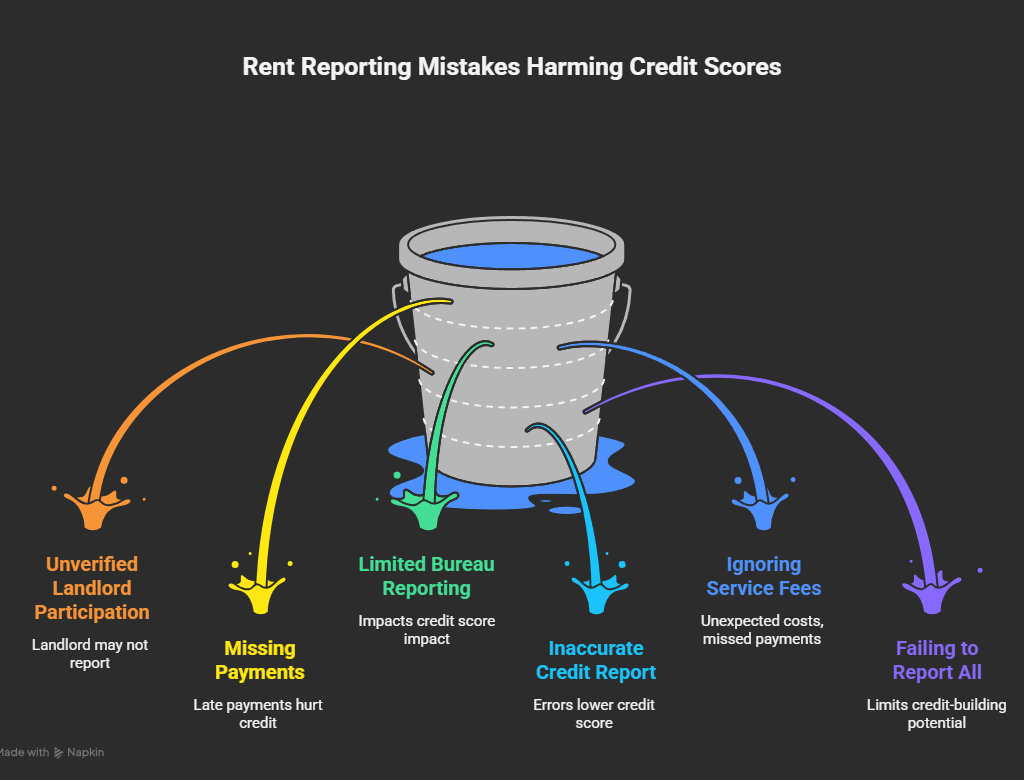
1. Not Verifying If Your Landlord Participates
Mistake: Assuming your landlord reports payments automatically. Most landlords don’t report to credit bureaus unless you use a third-party service like AxcessRent.
Fix: Ask your landlord if they report payments. If not, sign up for a service like AxcessRent or Experian Boost. These platforms verify payments with your landlord or bank statements.
Tip: Confirm your landlord’s willingness to verify payments before enrolling. Some may refuse.
2. Missing or Late Rent Payments
Mistake: Late rent payments, if reported, hurt your credit score significantly. Payment history is 35% of your FICO score, and one late payment can lower it by 50–100 points.
Fix: Set up auto-pay through your bank or rental platform to ensure on-time payments. Use budgeting apps like Mint to track due dates. If you’re late, pay immediately and ask your landlord to report it as on-time if it’s within a grace period (e.g., 5 days).
Example: Sarah missed a $1,000 rent payment due to a bank error. She paid within three days, and her landlord agreed not to report it as late to AxcessRent, saving her score.
Tip: Keep a small emergency fund ($500–$1,000) to cover unexpected delays.
3. Choosing a Service That Reports to Only One Bureau
Mistake: Using a rent reporting service that doesn’t report to all three major bureaus (Equifax, Experian, TransUnion). Limited reporting reduces the impact on your credit score.
Fix: Pick a service like AxcessRent, which reports to all three bureaus. Confirm this before signing up. Experian Boost, while free, only reports to Experian, which may not help if lenders check other bureaus.
Mistake to Avoid: Not reading the fine print about bureau reporting.
4. Not Checking Your Credit Report for Errors
Mistake: Assuming reported rent payments are accurate. Errors, like missed or incorrect payments, can lower your score.
Fix: Check your credit report monthly at AnnualCreditReport.com. Look for your rent payments under the “payment history” section. If there’s an error (e.g., a payment marked late), dispute it with the bureau and provide proof like bank statements or AxcessRent reports.
Example: John noticed a $1,200 rent payment was missing from his TransUnion report. He submitted proof via AxcessRent, and the error was fixed in two weeks.
Tip: Monitor your score with Credit Karma to catch issues early.
5. Ignoring Fees for Rent Reporting Services
Mistake: Signing up for a service without understanding costs. Some services charge high fees (e.g., $10–$20/month), which may not be worth it if your rent is low.
Fix: Compare services. AxcessRent , Experian Boost is free for basic features. If your rent is $500/month, a free service may suffice. For higher rents ($1,500+), paid services reporting to all bureaus are more impactful.
Mistake to Avoid: Not budgeting for service fees, which can lead to missed payments.
6. Failing to Report All Eligible Payments
Mistake: Only reporting rent and not other payments like utilities. This limits your credit-building potential.
Fix: Use Experian Boost to report utilities and phone bills alongside rent. For example, reporting $100/month in utilities and $1,200 in rent can boost your score faster than rent alone.
Tip: Ensure all payments are verified by your bank or landlord to count.
7. Not Starting Rent Reporting Early
Mistake: Waiting to report rent until you need a better credit score. Building credit takes time—6–12 months for noticeable results.
Fix: Start reporting as soon as you sign a lease. Even one year of $1,000/month payments can raise your score from 550 to 650, per Experian data.
Example: Maria, a new renter, started with AxcessRent on her first lease. By year-end, her score rose 70 points, helping her qualify for a car loan.
Mistake to Avoid: Delaying reporting, thinking short-term payments are enough.
8. Misunderstanding How Late Payments Are Reported
Mistake: Assuming late payments won’t be reported. If you use a reporting service, late payments go on your credit report, just like on-time ones.
Fix: Clarify your landlord’s grace period (e.g., 5–7 days). Pay within it to avoid late marks. If you’re late, negotiate with your landlord to report it as on-time if it’s a one-time issue.
Tip: Keep written records of any agreements with your landlord.
9. Not Addressing Past Late Payments
Mistake: Ignoring late rent payments already on your credit report. These can stay for seven years, dragging your score down.
Fix: Dispute errors if the late payment was incorrect. If valid, ask your landlord to remove it as a goodwill gesture, especially if you’ve been consistent since. Alternatively, focus on reporting on-time payments to dilute the negative impact over time.
Example: Alex had a late payment from 2023. He used AxcessRent to report two years of on-time payments, and his score recovered from 580 to 640.
Mistake to Avoid: Assuming late payments will “fix themselves” without action.
10. Overlooking Privacy Concerns
Mistake: Sharing sensitive financial data with unverified services, risking scams or data breaches.
Fix: Choose reputable services like AxcessRent or Experian Boost, which comply with GDPR and CCPA regulations. Check reviews and confirm they use secure encryption.
Tip: Avoid services asking for unnecessary personal info, like social media logins.
Overcoming Late Payment Fears
Many renters avoid reporting due to fears of late payments hurting their credit. Here’s how to address those concerns:
- Fear: “I’ll miss a payment and tank my score.”
Solution: Set up auto-pay through your bank or rental platform. Keep a $500–$1,000 emergency fund for unexpected expenses. For example, if rent is $1,200, auto-pay ensures it’s never late, and an emergency fund covers surprises like car repairs. - Fear: “My landlord will report every small delay.”
Solution: Confirm your landlord’s grace period (usually 5–7 days). Most reporting services only mark payments late after this period. Ask your landlord to verify payments manually if you’re within the grace period. - Fear: “I have a bad rental history.”
Solution: Be honest about past issues (e.g., one late payment due to job loss). Start reporting now to show improvement. AxcessRent lets you report current payments, which can outweigh older negatives over time. - Fear: “It’s too complicated.”
Solution: Services like AxcessRent simplify the process. You sign up, link your payments, and they handle reporting. It takes 5–10 minutes to set up.
Example: Lisa worried about late payments due to irregular income. She set up auto-pay and used Mint to budget $1,300/month for rent and utilities. After six months with AxcessRent, her score rose 50 points without issues.
Benefits of Rent Reporting Done Right
Avoiding mistakes and managing fears unlocks these benefits:
- Improved Credit Score: On-time payments can raise your score by 20–100 points in 6–12 months.
- Better Financial Opportunities: Higher scores mean easier loan approvals and lower interest rates, saving thousands.
- Stronger Rental Applications: A good credit score impresses landlords in competitive markets.
- Financial Discipline: Reporting encourages timely payments, building better habits.
- Job Application Boost: Employers checking credit see your reliability, especially for finance roles.
For instance, a renter reporting $1,500/month via AxcessRent for a year raised their score from 560 to 650, qualifying for a car loan with a 5% lower rate, saving $2,000 over the loan term.
Challenges and Considerations
Rent reporting isn’t perfect. Watch for these challenges:
- Limited Bureau Reporting: Some services only report to one bureau, reducing impact. Use AxcessRent for all three.
- Costs: Paid services ($5–$20/month) add up. Compare to free options like Experian Boost.
- Landlord Cooperation: Some landlords won’t verify payments. Provide bank statements as proof.
- Negative Reporting: Late payments hurt your score. Stay consistent with auto-pay.
Mistake to Avoid: Starting without a plan to pay on time, as negative marks last seven years.
State-Specific Rent Reporting Rules
Rent reporting regulations vary by state in 2025:
- California: Strict tenant laws may limit landlord reporting. Use AxcessRent to ensure compliance.
- New York: High rental demand makes reporting competitive. Formal reports stand out.
- Ohio: Flexible rules favor services like AxcessRent.
- Florida: No rent control simplifies reporting, but verify landlord participation.
Check your state’s consumer protection website for updates, as 2025 laws may expand reporting options.
Tools and Resources for Rent Reporting
- AxcessRent: Reports rent to all major credit bureaus. Ideal for renters.
- Experian Boost: Free tool for rent and utility reporting to Experian.
- Credit Karma: Free score tracking to monitor reporting impact.
- AnnualCreditReport.com: Free credit reports to check for errors.
- Mint: Budgeting app to ensure on-time payments.
- NFCC.org: Credit counseling for reporting guidance.
Conclusion
Rent reporting is a game-changer for building credit in 2025, but mistakes like missing payments or choosing the wrong service can hurt your score. By avoiding the 10 common errors outlined—such as not verifying landlord participation or ignoring credit report errors—you can maximize the benefits. Overcome late payment fears with auto-pay, an emergency fund, and tools like AxcessRent. Start today by checking your credit at AnnualCreditReport.com and signing up for a reporting service. For more credit-building tips, visit AxcessRent. Your rent can unlock better financial opportunities if done right.
FAQs on Common Rent Reporting Mistakes
What Are Common Rent Reporting Mistakes?
Common mistakes include not verifying landlord participation, missing payments, choosing services that report to only one bureau, ignoring credit report errors, and not addressing past late payments. Fix by using AxcessRent, setting up auto-pay, and checking reports regularly.
How to Fix Late Rent Payments on Credit Reports?
Dispute errors with proof (e.g., bank statements) via AnnualCreditReport.com. For valid late payments, ask your landlord for a goodwill removal or focus on reporting on-time payments to dilute the impact. AxcessRent helps build positive history.
Can Late Rent Payments Hurt My Credit Score?
Yes, if reported to bureaus, late payments can drop your score by 50–100 points. Prevent this with auto-pay and a grace period agreement. Pay late payments quickly to minimize damage.
How to Avoid Rent Reporting Mistakes?
Choose a service like AxcessRent that reports to all bureaus, set up auto-pay, check your credit report monthly, and confirm landlord participation. Budget for service fees and maintain an emergency fund.
What If My Landlord Doesn’t Report Rent Payments?
Use AxcessRent or Experian Boost to report payments yourself. Provide bank statements or receipts as proof. Confirm the service reports to all three bureaus for maximum impact.
How to Overcome Fears of Late Payments in Rent Reporting?
Set up auto-pay and keep a $500–$1,000 emergency fund. Clarify your landlord’s grace period (5–7 days). Use budgeting apps like Mint to stay on track. Start reporting early to build a buffer of positive payments.
Is Rent Reporting Worth the Risk of Late Payments?
Yes, if you pay on time. Reporting can raise your score by 20–100 points, improving loan and job prospects. Use auto-pay and reputable services like AxcessRent to minimize risks.